
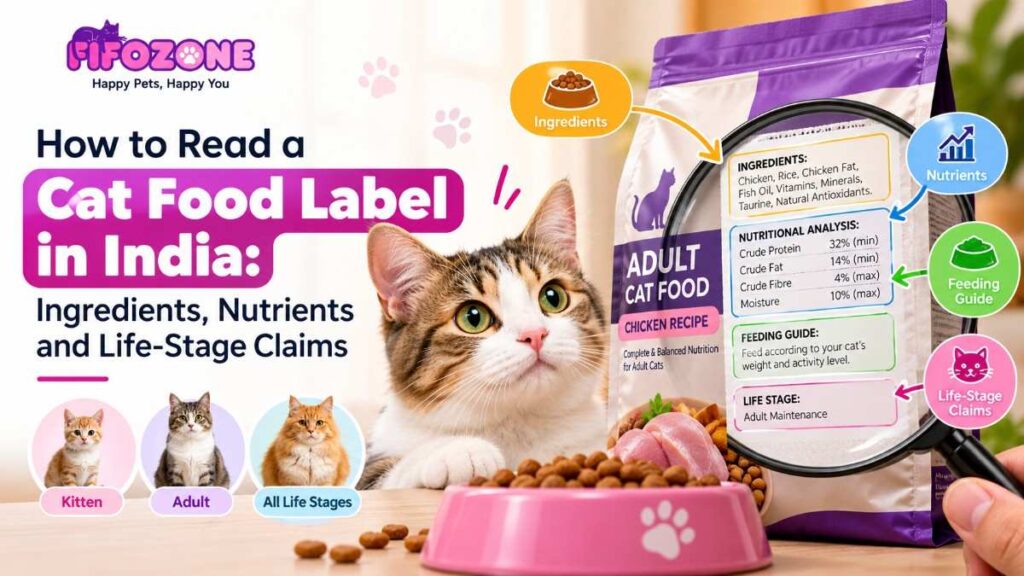
It’s simpler to choose cat food if you know what the label really says. The ingredient list, the nutritional information, the claims regarding the cat’s life stage and the feeding instructions can all help you to decide whether or not the product is suitable for your cat. This guide outlines how to read cat food labels in India, how to compare different products properly, and how to avoid depending solely on the claims made on the front of the package.
What should you check first?
When reading a cat food label, check these five things first:
- Life stage: Is it made for kittens, adult cats or all life stages?
- Nutritional adequacy: Is it a complete food or intended only for supplementary feeding?
- Ingredients: What ingredients are listed, and in what order?
- Nutritional analysis: Check protein, fat, fibre, moisture and other declared nutrients.
- Feeding instructions: How much should you feed, and how should the food be stored?
What Information Should You Look for on a Cat Food Label?
The information on a cat food label can help you to evaluate the product prior to purchasing it. You should begin by looking at the life stage it’s intended for, the list of ingredients, the nutritional analysis, the feeding guide, the net weight and the manufacturer’s details. Alone, the statements on the front of the label such as “premium”, “natural” or “high protein” are not as useful for comparing products as these details.
Look for these details on the pack:
- Product name and intended animal
- Ingredient list
- Guaranteed or typical nutritional analysis, depending on the label
- Complete-food or supplementary-feeding statement
- Recommended feeding amount
- Net weight and storage instructions
- Manufacturer or distributor details, batch information and expiry or best-before date, where provided
How to Read the Ingredients List on Cat Food
The list of ingredients indicates the various components contained in the food, generally being arranged in order of weight before processing. It enables you to see which ingredients are present, but it does not show the exact quantity of each ingredient nor does it prove that the product is nutritionally complete. You should read it together with the nutritional statement and in relation to the product’s intended life stage.
Does the First Ingredient Always Mean Better Cat Food?
It doesn’t have to be. Although the first ingredient is usually the one that is present in the largest amount by weight before processing, the moisture content can influence its ranking. A named meat ingredient might contain a lot of water, whereas a dry ingredient could be more concentrated. Rather than selecting cat food on the basis of the first ingredient alone, consider the entire formula and the nutritional information.
What Do Meat, Fish and Animal By-Products Mean?
Meat, fish and animal by-products are all capable of providing useful nutrients as long as they are properly chosen and incorporated into cat food. The fact that an ingredient is called a ‘by-product’ does not mean that it is unsafe or of low quality; what is important is the identity of the ingredient, the role it plays in the formula and whether the final food gives your cat the appropriate nutrition for its life stage.
How to Understand Protein, Fat, Fibre and Moisture
Nutritional analysis reports state the guaranteed levels of some nutrients, usually specifying a minimum amount of crude protein and fat and a maximum amount of crude fiber and moisture. Although these figures are useful for comparing products, they require some context, especially since dry food and wet food contain very different quantities of water and therefore their stated protein percentages cannot always be compared directly.
| Label term | What it tells you |
| Crude protein | A measure of protein content, not a full breakdown of protein quality |
| Crude fat | The declared fat level, which contributes energy and essential fatty acids |
| Crude fibre | An estimate of fibre content |
| Moisture | The amount of water in the food |
| Ash, if listed | A measure of the total mineral residue after testing |
| Calories or energy | Helps you assess how much food your cat may need |
Why You Should Not Compare Wet and Dry Cat Food by Protein Percentage Alone
Since wet cat food contains more water than dry food, the percentage of protein on the label may appear lower even if the comparison is not direct. In order to make a fair comparison of the nutrient content, the dry-matter basis should be used instead of the as-fed percentages. This allows for a more meaningful comparison between foods that have very different moisture levels.
For a basic dry-matter calculation:
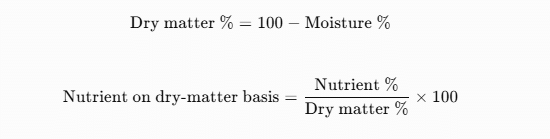
For example, if a food lists 10% protein and 78% moisture, its dry matter is 22%. Its protein level on a dry-matter basis is approximately 45.5%. This calculation helps with comparisons; it does not by itself prove that the food is suitable or complete.
What Does “Complete and Balanced” Cat Food Mean?
Cat food that is complete is meant to supply the nutrients that a cat requires when fed according to the instructions. For nutrients to be described as ‘balanced’ means that they are provided in the right amounts and in the correct proportions. You should refer to the product’s nutritional adequacy statement and the life stage it is intended for, since treats, toppers and supplementary foods may not have been designed so that they can meet all of your cat’s nutritional needs when eaten as the only food.
Before buying, check whether the label describes the product as:
- Complete food: Intended to provide a full diet when fed as directed.
- Complementary or supplementary food: Intended to be fed alongside other food, not necessarily as the only diet.
- Treat or snack: Usually offered in addition to a complete diet.
For Indian shoppers it should be noted that the wording of labels and the regulatory requirements can differ from one market to another. Although the AAFCO guidance is a helpful reference when it comes to understanding nutritional statements, it cannot be assumed that all products imported or sold locally comply with the same labelling rules. You should read the label on the specific package and get in touch with the manufacturer if any claim is unclear.
How to Check Kitten, Adult and Senior Cat Food Claims
Cat food should be suitable to the cat’s life stage since its nutritional requirements vary with growth, adulthood, pregnancy and nursing. Food formulated for kittens is meant for promoting growth, whereas food for adult cats is intended for the maintenance of mature animals. In the case of older cats, age by itself is not enough to decide on the correct diet; individual health, weight and advice from a veterinarian may also be important.
| Life-stage claim | What to check |
| Kitten or growth | Intended for growing kittens and their higher growth-related needs |
| Adult maintenance | Intended for maintaining adult cats |
| All life stages | Check the feeding guidance and suitability for your cat |
| Senior or mature | Review the stated purpose and whether it suits your cat’s health needs |
| Pregnancy or nursing | Confirm the food is intended for reproduction or the relevant life stage |
Do not assume that food labelled for adult cats is suitable for kittens. If you are choosing food for a kitten, compare products in the FifoZone kitten food collection and verify each product’s stated age range.
How to Read “High Protein,” “Grain-Free” and “Natural” Claims
Words like ‘high protein’, ‘grain-free’ and ‘natural’ refer to specific characteristics of a product, but this does not mean that the food is better for every cat. Before making a decision you should look at the ingredient list, the nutritional analysis and the complete-food statement. A product must be evaluated in terms of its overall suitability rather than on the basis of a single appealing claim on the packaging.
- High protein: Check the actual protein level and consider moisture when comparing wet and dry food.
- Grain-free: Means the formula excludes grains; it does not automatically mean the food is healthier.
- Natural: Check what the manufacturer means by the term and read the full ingredient list.
- Premium: Treat this as a marketing description unless clear product information supports a specific benefit.
- With chicken or fish: Read the full ingredient list and any explanatory details rather than assuming the product consists mainly of the named ingredient.
If you are comparing different formulas, browse FifoZone’s dry cat food and wet cat food collections. Check the individual product labels before making a choice.
How to Read Feeding Instructions and Calorie Information
The feeding guidelines will allow you to work out how much food to give your cat according to its weight and age, although they only serve as a starting point and not a set quantity that should apply to all cats. Whenever calorie information is available, check it, measure out the portions consistently and keep an eye on your cat’s body condition. If your cat gains or loses weight unexpectedly, consult your veterinarian for advice.
When reading the feeding guide:
- Check whether the amount is for a full day or each meal.
- Confirm the instructions match your cat’s age and weight.
- Account for treats and any additional food.
- If combining wet and dry food, adjust portions so you do not unintentionally overfeed.
- Provide fresh drinking water at all times.
How to Check Cat Food Quality Before Buying Online in India
When buying cat food online in India, read the product details carefully before placing an order. Check the life-stage recommendation, ingredients, nutritional analysis, pack weight and storage instructions. Also review the expiry or best-before date where shown and confirm that the product is appropriate for your cat. Product images and marketing descriptions should support not replace the label information.
Use this quick checklist before ordering:
- Is the product specifically made for cats?
- Is it suitable for your cat’s life stage?
- Is it a complete food or a supplementary product?
- Are the ingredients and nutritional details available?
- Does the pack size fit your feeding routine?
- Are storage instructions and product dates clear?
- Is the product description consistent with the packaging?
At FifoZone, you can browse the cat food collection and compare available options. Always check the individual listing and packaging for the product-specific details.
Common Mistakes to Avoid When Reading Cat Food Labels
The main mistake is to select cat food on the basis of a single claim, for example a high protein content, a named meat ingredient or a premium label. It is also a common mistake to compare the percentages of wet and dry food without taking the moisture content into account. Only after looking at the full nutritional statement, the life stage and the feeding instructions should you decide whether or not the product is suitable for your cat.
Avoid these common mistakes:
- Choosing adult food for a kitten without checking suitability.
- Assuming every wet food is a complete meal.
- Treating “grain-free” as proof of better nutrition.
- Comparing protein percentages without considering moisture.
- Ignoring feeding amounts and calorie information.
- Assuming an ingredient list alone proves nutritional adequacy.
- Using a special diet to manage a health condition without veterinary guidance.
How to Choose Cat Food After Reading the Label
Choose cat food by considering the whole label rather than relying on a single ingredient or marketing claim. First match the food to your cat’s life stage, then check whether it is complete and balanced, review the nutritional analysis and follow the feeding guide. If your cat has a health condition or special dietary needs, seek veterinary advice before changing its food.
Understanding a cat food label is the first step towards choosing the right food for your pet. If you want to compare dry and wet food, understand the needs of kittens and adult cats, and choose a suitable option for your cat, read our practical guide on how to choose cat food in India.
A simple decision process is:
- Match the life stage: kitten, adult or another stated category.
- Check the food type: complete meal or supplementary feeding.
- Read the nutrients: consider protein, fat, moisture and calories.
- Review the feeding guide: choose a suitable portion and routine.
- Compare products fairly: account for moisture and pack size.
- Ask for help when needed: consult a veterinarian about medical or special dietary needs.
See It on a Real Pack: An Annotated Sample Cat Food Label
The best way of understanding a cat food label is to look at an example and work out what each part informs you about. A label can include the product name, the ingredients, the nutrient levels, the life stage it is suitable for, the feeding instructions and information about the manufacturer. You should read all the sections together since no one ingredient or statement on its own can tell you if the food is appropriate for your cat.
Illustrative cat food label
Fictional example for learning purposes only. This is not a real product or a verified nutritional formula.
Adult Cat Food – Chicken Recipe
Net weight: 1 kg
Ingredients
Chicken, rice, chicken fat, fish oil, vitamins and minerals, taurine.
Typical label analysis
| Nutrient | Example value |
| Crude protein | 32% minimum |
| Crude fat | 14% minimum |
| Crude fibre | 4% maximum |
| Moisture | 10% maximum |
Life stage: Adult maintenance
Feeding guide: Follow the manufacturer’s directions based on your cat’s weight and needs.
Storage: Follow the instructions printed on the pack.
Here is how to interpret the example:
- Product name: Identifies the food and its stated flavour or recipe.
- Ingredients: Shows the listed ingredients, generally ordered by weight under common pet-food labelling systems.
- Nutrient analysis: Gives declared nutrient levels; minimum and maximum values are not necessarily exact amounts.
- Life stage: Indicates the intended feeding stage, which must be checked against the product’s nutritional statement.
- Feeding and storage instructions: Help you serve and store the product as directed.
What Must Be on an Indian Cat Food Label (and What Is Voluntary)?
When buying cat food in India, check the product identity, net quantity, manufacturer or importer details, price and date information, along with ingredients and nutritional information where provided. The exact legal requirements depend on the product classification and applicable rules. Do not assume that every international pet-food labelling standard automatically applies to products sold in India.
What should you check on the pack?
| Label detail | Why it matters |
| Product name and intended animal | Confirms that the product is meant for cats |
| Net quantity | Shows how much food the pack contains |
| Manufacturer, packer or importer details | Helps identify the responsible business |
| Country of origin, where applicable | Helps identify where an imported product was made |
| MRP and applicable date declarations | Helps you check price and product freshness |
| Ingredients and nutrient information | Helps you assess the formula and compare products |
| Batch or lot code | Helps identify a specific production batch |
| Feeding and storage instructions | Supports correct use of the product |
Some information is required under applicable packaging or product-specific rules, while other details may be voluntary, depending on the claim and the product. Marketing phrases such as “premium,” “indoor formula” or “natural” should not be treated as substitutes for factual product information.
Important: India’s Legal Metrology (Packaged Commodities) Rules contain declarations for applicable pre-packaged retail commodities, including quantity, price and responsible-business details. Requirements and exemptions can differ, so verify the current rules and product classification before making a legal compliance claim.
Decode the Product Name: Chicken, Chicken Recipe, Chicken Flavour and More
The name on a cat food pack tells you how the manufacturer presents the product, but it does not always reveal the exact amount of each ingredient. Words such as “with chicken,” “chicken recipe” and “chicken flavour” can communicate different things. Read the full ingredient list and any explanatory statement instead of judging the formula by its name alone.
| Product wording | What you should do |
| Chicken cat food | Check the ingredient list and nutritional information |
| With chicken | Read the full recipe and any percentage declaration |
| Chicken flavour | Check how the flavour is described and which ingredients are listed |
| Chicken and fish recipe | Review both named ingredients and the complete formula |
| Premium chicken food | Treat “premium” as a claim, not proof of better nutrition |
Specific product-name rules vary by country. For example, AAFCO’s US guidance uses different criteria for names that emphasise an ingredient, use “with,” or describe a flavour. Those US thresholds should not be assumed to be the legal rules for every cat food sold in India.
The practical lesson is simple: a chicken-related name does not tell you everything about the product’s nutritional value. Check the complete formula, intended life stage and nutritional adequacy statement before choosing.
Preservatives and Additives in Cat Food: What Should You Know?
Preservatives and various other additives have practical uses in cat food, for example, they can help keep the food fresh, contribute nutrients, or aid the texture and consistency. The fact that they are included does not mean that the product is unsafe. Instead, you should look at the ingredient list, find out the purpose of the additive where this is known, and refer to the manufacturer’s information rather than suppose that every unknown name must be harmful.
Common additive types
| Type | Why it may be included |
| Preservatives | Help control spoilage or oxidation |
| Vitamins and minerals | Supply essential nutrients |
| Amino acids, such as taurine | Help meet cats’ specific nutritional needs |
| Thickeners and stabilisers | Help maintain texture in some wet foods |
| Antioxidants | Help protect fats from oxidation |
Certain labels include substances like mixed tocopherols or other preservatives by name, but merely having the name does not allow one to assess whether an ingredient is safe; it is necessary to take into account the permitted use of the ingredient, the quantity used, the entire formulation and the quality of the product. AAFCO states that pet food ingredients and additives have to satisfy the relevant conditions for their use within the applicable US framework and the Indian requirements should be verified separately.
Be cautious of articles that describe every chemical-sounding ingredient as dangerous or claim that “preservative-free” automatically means healthier. If your cat has a diagnosed allergy, intolerance or medical condition, ask your veterinarian before changing its food.
Functional Cat Food Claims: Indoor, Hairball, Sterilised and Urinary
Functional cat food labels describe products designed around a particular need or lifestyle, but the wording alone does not prove that a formula will deliver a specific result. “Indoor,” “hairball,” “sterilised” and “urinary” can refer to different nutritional goals. Read the intended use, nutritional statement and feeding directions, and seek veterinary advice when the claim relates to a medical concern.
| Claim on the pack | What to check |
| Indoor | Intended calorie level, feeding guide and suitability for your cat |
| Hairball | The product’s stated purpose and relevant nutritional details |
| Sterilised | Whether the formula suits your cat’s life stage and energy needs |
| Urinary | The specific intended use and any veterinary guidance required |
Does “urinary” cat food treat urinary disease?
It doesn’t have to be. Just because a product is labelled as being for urinary health does not mean that it will treat all urinary conditions. Separate conditions may call for different dietary measures, and urinary problems might need a quick veterinary evaluation. If your cat is having difficulty urinating, keeps going to the litter tray repeatedly, or produces only small amounts or no urine at all, you should get urgent veterinary care instead of depending on the food’s label.
Similarly, a “sterilised” or “indoor” claim does not remove the need to monitor portions and body condition. Choose food based on your cat’s individual needs rather than assuming a label category is always the best fit.
Batch Codes, Dates and Imported Cat Food Details
Batch codes and date markings allow you to verify the identity and freshness of packaged cat food. Before you buy it, make sure that the best-before or expiry date is given where possible, that the lot or batch code is available, that the storage instructions are provided and that the name of the manufacturer or importer is listed. With regard to imported products, also check the country-of-origin declaration when this is required and ensure that any extra information on the label is clear and consistent.
What do these details mean?
- Batch or lot code: Identifies a particular production batch and can help the manufacturer trace a product.
- Manufacturing or packing date: Indicates when the product was made or packed, as stated on the label.
- Best-before or expiry information: Helps you understand the product’s stated period of suitability; follow the exact wording on the pack.
- Country of origin: Identifies the origin declared for an imported product, where required.
- Importer details: Help identify the business responsible for importing or distributing the product in India.
- Storage instructions: Explain how the product should be kept before and after opening.
Do not buy a pack if its date information is unreadable, the packaging is damaged, or the seal appears compromised. If the batch code or date is unclear, ask the seller or manufacturer to confirm the details before feeding the product to your cat.
For online purchases, compare the listing with the packaging information available and check the product when it arrives. The Legal Metrology framework includes declarations for applicable pre-packaged commodities; exact requirements should be checked against current rules and any product-specific provisions.
Frequently Asked Questions
1. How do I read a cat food label correctly?
Begin by looking at the claim regarding the life stage and determine whether the product is a complete food or is intended for supplementary feeding. Then, examine the ingredient list, the nutritional analysis, the feeding instructions and the calories if these are given. It is necessary to compare the products in context rather than making your choice based just on the first ingredient or a marketing claim.
2. Which ingredient should come first in cat food?
The ingredient that is usually the one found in the largest amount on a weight basis before processing is the first one listed. Yet merely looking at its position does not indicate the overall quality or the nutritional completeness of the food; to get a more accurate understanding of the product you should read the full ingredient list and also check the nutritional statement.
3. What does complete and balanced cat food mean?
Cat food that is complete and balanced is meant to supply the nutrients needed for the life stage indicated on the label provided the food is given according to instructions. Foods given as treats and any other supplementary foods will not contain all the things a cat needs if they are the only food eaten. So it is necessary to look at the product’s nutritional statement before deciding to make it the cat’s principal food.
4. How can I compare protein in wet and dry cat food?
It is necessary to check the moisture content before comparing the protein figures since wet food has a higher amount of water and so its protein percentage may seem lower when the figure is given on an as-fed basis. If both products are converted to a dry-matter basis then the comparison will be more fair, though the result by itself does not tell you which food is the best for your cat.
5. Is kitten food different from adult cat food?
Certainly. Food for kittens is designed with growth in mind, whereas food for adult cats is usually meant to support maintenance. Since their nutritional requirements are different, you should look at the life stage statement rather than making your choice based just on taste or brand. If your kitten has any special dietary or health needs, you should ask your veterinarian for advice.
6. Is grain-free cat food better for cats?
It is not automatic by itself; although grain-free cat food does not contain grains, this fact does not mean that it provides better nutrition or is suitable for all cats. You should look at the full ingredient list, the nutritional adequacy statement and the life-stage recommendation. If your cat is believed to have a food allergy or intolerance, it is advisable to ask a veterinarian before making a change to its diet.
7. What should I check when buying cat food online in India?
Look at the product’s stated intended life stage, the complete-food or supplementary-feeding statement, the ingredients, the nutritional information, the feeding guide and the pack size. Where possible, check the product details and the packaging information. If anything important is not clear, get in touch with the seller or the manufacturer before making the purchase, in particular when the food is meant for a kitten or for a cat with special requirements.


Leave a Comment & Share Your Advice
Your experience can help other pet parents!
Top Comments