
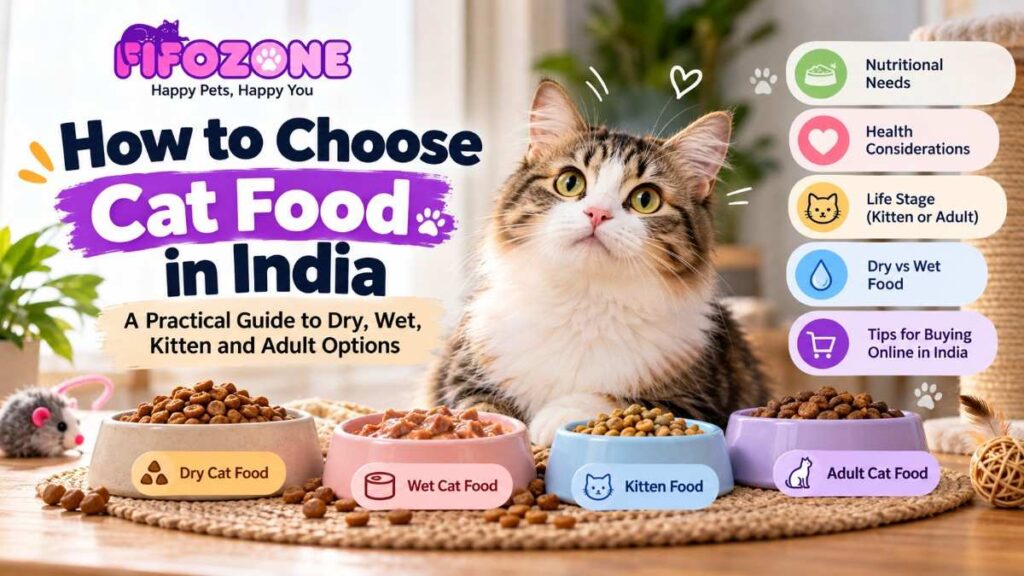
When choosing cat food you can find it difficult because there is dry food, wet food, food specially formulated for kittens, food formulated for adults, grain-free varieties, different ingredients, various brands and various pack sizes. The correct choice is influenced less by advertising claims and more by your cat’s age, life stage, nutritional requirements, preferences, feeding routine and general condition.
This guide explains how to choose cat food in India, what to check on the label, the difference between dry and wet cat food, when kittens should eat kitten food, and how to choose a suitable food for an adult cat.
The best cat food is one that is formulated for cats, appropriate for your cat’s life stage, nutritionally complete and balanced for its intended use, and suitable for your cat’s individual needs. When comparing products, check the nutritional adequacy information, feeding directions, ingredients, calories, moisture, pack size and your cat’s response rather than choosing only by price or marketing claims.
How Do You Choose the Right Cat Food?
When choosing cat food, start by considering your cat’s age and life stage, then pick a nutritionally complete and balanced product that is designed for cats. You should compare the label, the feeding instructions, the calorie content, the ingredients, the moisture level, and your cat’s own preferences. If your cat is a kitten, select a food that is formulated for growth; if your cat is an adult, go for one that is suitable for adult maintenance unless your veterinarian suggests otherwise.
Start With Your Cat, Not the Brand
There is no single cat food that is automatically best for every cat.
Before comparing brands, consider:
- Your cat’s age
- Kitten or adult life stage
- Activity level
- Body condition
- Feeding preferences
- Dry or wet food preference
- Any known dietary sensitivities
- Existing health concerns
- Whether your veterinarian has recommended a specific diet
A mature adult cat has different nutritional needs from a young kitten since kittens grow quickly and usually need a type of food designed for growth rather than just eating one that is meant for adult maintenance. It is also advised by veterinary experts to feed kittens a suitable growth diet while they are still growing.
For a healthy adult cat, an adult-maintenance food may be more appropriate than a calorie-dense growth formula.
A Simple Decision Process
Use this order when choosing cat food:
- Identify your cat’s life stage.
- Choose food specifically formulated for cats.
- Look for appropriate nutritional adequacy information.
- Compare dry and wet formats based on your cat and routine.
- Check feeding instructions and calorie information.
- Consider ingredients and nutritional information together.
- Choose a pack size that suits your cat and storage conditions.
- Monitor your cat after changing food.
The nutritional adequacy statement is particularly useful because it tells you whether a product is intended to provide complete and balanced nutrition for a particular species and life stage.
Dry Cat Food vs Wet Cat Food: Which Is Better?
Neither dry nor wet cat food is automatically better for every cat. Dry food is convenient, easy to store and simple to portion, while wet food contains substantially more moisture and may be useful for cats that benefit from increased water intake. The best choice depends on nutritional completeness, your cat’s needs, preferences and feeding routine.
| Factor | Dry Cat Food | Wet Cat Food |
| Moisture | Lower | Higher |
| Storage | Convenient after opening | Usually requires more careful storage after opening |
| Portioning | Easy | Easy, but portions may vary by product |
| Convenience | Very convenient | Convenient but needs more handling |
| Palatability | Depends on the cat | Many cats find wet textures appealing |
| Water contribution | Lower | Higher |
| Variety | Kibble sizes and formulas vary | Mousse, gravy, chunks and other textures may be available |
| Best choice | Depends on the individual cat | Depends on the individual cat |
Wet food has a much higher water content than dry food, which can be useful for cats that do not drink much. However, that does not mean every cat needs an exclusively wet diet.
The more important question is whether the food provides appropriate nutrition and works well for your individual cat.
When Dry Cat Food May Be Convenient
Dry Cat food can work well for households that value:
- Easy storage
- Simple portion control
- Convenient feeding
- Easy measurement
- Longer storage after opening when properly stored
However, dry food should not be selected simply because it is convenient. The product still needs to be appropriate for your cat’s life stage and nutritional requirements.
When Wet Cat Food May Be Useful
Wet cat food can be particularly useful when:
- Your cat prefers wet textures
- You want to increase moisture intake through food
- Your cat has difficulty eating certain dry textures
- You want to provide more variety in feeding
For cats with medical conditions, however, food selection should be discussed with a veterinarian rather than based solely on a general online guide.
Can You Feed Both?
Yes, a cat’s diet can include both dry and wet food when the overall feeding plan is appropriate.
If combining foods, do not simply add the normal full portion of one food on top of the normal full portion of another. Total daily intake matters.
Follow each product’s feeding guidance and adjust portions appropriately.
Kitten Food vs Adult Cat Food: What Is the Difference?
Kitten food is formulated for growth, while adult cat food is generally formulated for adult maintenance. Growing kittens need different amounts and ratios of nutrients and often have higher energy requirements than mature cats. Therefore, an adult cat food should not automatically replace a kitten formula simply because the kitten eats it willingly.
Why Kittens Need Different Food
Kittens grow quickly during their early months.
Their nutritional requirements are different because their bodies are developing rapidly. Veterinary guidance recommends food formulated specifically for growth during the kitten stage.
When shopping for kitten food, look for:
- Food specifically intended for kittens or growth
- Appropriate nutritional adequacy information
- Feeding directions for the kitten’s size and age
- Suitable calorie content
- A formulation from a reputable manufacturer
- Packaging information that clearly identifies the intended species and life stage
What About an Adult Cat?
Adult cats generally need a diet designed around adult maintenance rather than the higher nutritional demands of growth.
Feeding a calorie-dense growth diet to an adult cat without considering its total calorie intake may contribute to excessive weight gain.
That is why kitten vs adult cat food is not simply a matter of choosing the more expensive product.
It is about choosing food for the correct life stage.
When Should a Kitten Switch to Adult Cat Food?
The exact transition should depend on the kitten’s development, size, health and veterinary advice.
Many veterinary guidelines consider approximately 12 months a common point at which cats have completed much of their growth, although individual cats can differ. VCA guidance notes that kittens can begin a gradual transition around 10 months so that they are fully transitioned around 12 months.
A gradual transition is generally preferable to suddenly replacing one food with another.
What Should You Check on a Cat Food Label?
Make sure to check the species, the stage of life, the nutritional adequacy statement, the feeding instructions, the ingredients, the guaranteed nutritional information, the calorie content, the quantity of the product and the details of the manufacturer. You should not base your judgment of a cat food solely on the first ingredient or on a marketing claim listed on the front of the package. A more reliable basis for comparison is provided by the complete nutritional profile and the intended use.
1. Species
Make sure the product is intended for cats.
Cat and dog nutritional requirements are not identical. Cats require specific nutrients that make species-appropriate formulation important.
2. Life Stage
Look for information indicating whether the food is intended for:
- Growth/kitten
- Adult maintenance
- All life stages
- Other specific purposes
Different life stages require different nutrient amounts and ratios.
3. Nutritional Adequacy Statement
This is one of the most useful parts of the label.
A complete and balanced product is intended to provide the nutrients required for the stated species and life stage when fed according to the product’s directions.
4. Feeding Directions
Feeding instructions provide a starting point for determining how much food to give.
However, feeding recommendations are not necessarily identical for every cat. Activity, body condition and other individual factors matter.
5. Calorie Information
Calories matter because two products with similar-looking portions may provide different amounts of energy.
When comparing foods, look at the calorie information provided by the manufacturer rather than comparing serving sizes alone.
6. Ingredient List
Ingredients are useful for understanding what goes into the product, but the ingredient list should not be viewed in isolation.
AAFCO explains that ingredients contribute nutrients in different amounts and ratios, and complete nutrition depends on the formulation as a whole.
7. Guaranteed Nutritional Information
Check the nutritional information supplied on the package.
Do not assume that a product with a higher number for one nutrient is automatically better for every cat.
Is High-Protein Cat Food Always Better?
Just because a food has a higher protein content doesn’t mean that it is better for every cat. What is important is whether the full diet offers the appropriate nutrition for the cat’s age and its current condition. You should compare the entire formulation, the calorie content, the feeding instructions and the nutritional information rather than selecting a product simply because it is labelled ‘high protein’.
Cats do require protein as part of their diet, but choosing food should not be reduced to one number on the packaging.
A product can be marketed around:
- High protein
- Natural ingredients
- Premium ingredients
- Grain-free
- Meat-first recipes
- Indoor formulas
- Hairball formulas
These descriptions can be useful for understanding the product, but they should not replace checking whether the food is nutritionally appropriate for your cat.
AAFCO notes that creating a complete and balanced pet food is complex because many nutrients must be supplied in appropriate amounts and ratios.
Does Grain-Free Cat Food Mean It Is Healthier?
Grain-free does not automatically mean healthier for every cat. A grain-free formula may be appropriate for some specific dietary situations, but removing grains alone does not make a food nutritionally superior. Instead, compare the complete formulation, nutritional adequacy, ingredients, calories and suitability for your cat’s life stage.
The phrase grain-free cat food is often used as a product differentiator, but it should not become the only factor in your buying decision.
Ask:
- Is it complete and balanced?
- Is it intended for my cat’s life stage?
- Does my cat tolerate it well?
- Does it fit the feeding plan?
- Is the calorie content appropriate?
- Does my veterinarian recommend any specific dietary approach?
A food should be selected based on nutritional suitability rather than a single marketing characteristic.
How Much Cat Food Should You Give Your Cat?
Start with the feeding guidance provided on the specific cat food package and adjust the total amount according to your cat’s body condition, activity and individual needs. There is no single daily portion that is correct for every cat. When changing food, compare calorie content and avoid combining full portions of multiple foods.
Why There Is No Universal Portion
A 3 kg indoor cat and a larger, more active cat may have very different energy requirements.
The appropriate amount can depend on:
- Body weight
- Body condition
- Activity
- Age
- Neutering status
- Food calorie density
- Health status
- Feeding method
AAFCO explains that feeding directions are guidelines and may need modification according to an individual animal’s needs and body condition.
A Practical Approach
When you buy a new cat food:
- Read the feeding table.
- Identify the portion for your cat’s weight.
- Check whether the recommendation is for kittens or adults.
- Measure the food rather than guessing.
- Monitor body condition.
- Adjust with veterinary guidance if necessary.
For a cat with a medical condition, significant weight change or unusual appetite, consult a veterinarian instead of trying to solve the issue through general food recommendations.
How to Change Your Cat’s Food Safely?
Change cat food gradually rather than replacing the old food suddenly. Start by mixing a small amount of the new food with the existing food, gradually increase the new food and monitor your cat’s appetite, stool and general response. If your cat refuses food or develops concerning symptoms, seek veterinary advice promptly.
A simple transition can look like:
| Stage | Existing Food | New Food |
| Start | 75% | 25% |
| Next stage | 50% | 50% |
| Later stage | 25% | 75% |
| Final stage | 0% | 100% |
The exact pace can be adjusted depending on how your cat responds.
Some cats are particularly sensitive to changes in texture, smell or flavour, so a slower transition may be more practical.
Don’t Change Everything at Once
If you are introducing a new food, avoid simultaneously changing:
- Food brand
- Feeding schedule
- Treats
- Supplements
- Feeding bowl
- Feeding location
Making multiple changes at once makes it harder to understand what your cat is responding to.
How to Choose Cat Food Online in India?
When buying cat food online in India, compare the exact product, life stage, food type, ingredients, nutritional information, pack size, price, feeding guidance, availability and seller information. Do not choose only from a product image or discount. Before ordering, confirm that the product matches your cat’s age and dietary requirements.
When shopping online, compare products using a consistent checklist.
Online Cat Food Buying Checklist
Before adding a product to your cart, check:
- Cat or kitten formula?
- Dry or wet?
- Appropriate life stage?
- Complete and balanced where required?
- Ingredients clearly listed?
- Nutritional information available?
- Feeding instructions available?
- Pack size suitable?
- Product within its usable date?
- Storage instructions clear?
- Is the price per pack reasonable?
- Price per unit/weight worth comparing?
- Your cat already tolerates the ingredients?
- Is the product actually available?
This approach is more useful than simply searching for the best cat food in India and selecting the first product that appears.
Where Can You Buy Cat Food Online?
You can buy cat food online through established pet retailers, brand websites and ecommerce platforms that provide clear product information and reliable fulfilment. When choosing an online retailer, look beyond discounts and check product details, availability, delivery information, return policies and customer support. FifoZone can be used to compare available cat food products, formats and pack sizes.
Shopping Through FifoZone
FifoZone’s Cat Food section can be used to browse different cat food options and compare products based on the information provided on each listing.
How Do You Choose Between Different Cat Food Brands?
Compare cat food brands using the same criteria rather than choosing based only on reputation or price. Check whether the product is intended for cats, its life stage, nutritional adequacy, feeding guidance, calorie information, ingredients, product quality information and your cat’s tolerance. A consistent comparison method makes different brands easier to evaluate fairly.
Use This Comparison Framework
| Factor | What to Ask |
| Life stage | Is it suitable for my cat’s age? |
| Nutrition | Is it complete and balanced for its intended use? |
| Ingredients | Are the ingredients clearly listed? |
| Calories | How energy-dense is the food? |
| Food type | Dry, wet or combination? |
| Texture | Will my cat actually eat it? |
| Feeding | Are clear feeding directions provided? |
| Pack size | Is the quantity practical? |
| Cost | What is the cost per useful unit/weight? |
| Availability | Can I buy it consistently? |
The goal is not to find a universally “best” brand.
The goal is to find a suitable food for your particular cat.
What Are the Most Common Cat Food Buying Mistakes?
Common mistakes include choosing food only because it is expensive, focusing on one ingredient, ignoring life stage, changing food suddenly, overfeeding because the cat likes it, comparing dry and wet portions directly, and relying on marketing claims instead of the complete label. A better approach is to evaluate the whole product and your cat’s individual needs.
Avoid These Mistakes
1. Choosing only by price
Expensive does not automatically mean suitable.
2. Choosing only by the first ingredient
The full nutritional formulation matters.
3. Ignoring life stage
Kitten and adult nutritional requirements differ.
4. Assuming wet food is always better
Wet and dry food have different characteristics; suitability matters.
5. Changing food suddenly
A gradual transition can make the change easier for many cats.
6. Overfeeding
A cat can gain excess weight even when the food itself is nutritionally appropriate.
7. Following marketing claims blindly
Words such as “premium,” “natural” or “high protein” should not replace checking the actual nutritional information.
8. Ignoring water
Cats should have access to fresh, clean drinking water.
Quick Cat Food Decision Guide
If you’re looking for a simple option, then buy food suitable for a kitten that is growing and another type that is appropriate for an adult cat which is mature. After that, choose between dry food, wet food or a combination according to your cat’s preferences, its hydration requirements, your feeding schedule and the food’s nutritional value. Don’t forget to check the label and adhere to the feeding instructions.
| Your Cat | Starting Point |
| Young kitten | Kitten/growth formula |
| Healthy adult cat | Adult-maintenance formula |
| Cat that prefers wet textures | Consider wet food |
| Cat that eats dry food well | Dry food may be convenient |
| Cat that enjoys both | Combination feeding may be considered |
| Cat with a diagnosed condition | Ask your veterinarian |
| Cat with unexplained weight loss/gain | Veterinary assessment recommended |
| Very selective eater | Prioritize suitable texture and palatability while maintaining nutritional adequacy |
What Cats Actually Need: Obligate Carnivore Basics
The idea of cat nutrition is far simpler once you know one key fact, namely that cats are obligate carnivores. Since their bodies are adapted to derive essential nutrients from animal-based foods, feeding a cat is different from feeding a dog or just sharing human food from the kitchen.
The statement that “cats need meat” does not imply that feeding them meat by itself provides a complete diet; rather, cats require a carefully balanced mixture of nutrients, such as protein, amino acids, fatty acids, vitamins, minerals and water.
What Does It Mean That Cats Are Obligate Carnivores?
The simple answer is that cats are obligate carnivores since their biology is based on the nutrients that occur naturally in animal tissues; they need certain nutrients, for example taurine and preformed vitamin A, and these must be obtained from their diet. Yet this does not imply that cats should be fed meat on its own. Food that is designed to be complete provides the full range of nutrients that a cat requires.
Cats evolved as hunters and their natural diet contains substantial animal-derived nutrients.
According to Cornell University’s Feline Health Center, cats require nutrients found in animal products and have nutritional requirements that reflect their evolutionary biology.
This is why a cat’s diet should not be designed around the same principles used for humans.
The important distinction
There is a difference between:
“Cats need nutrients that are naturally abundant in animal tissue.”
and
“A bowl of plain chicken is a complete cat diet.”
The second statement is not correct.
A complete diet needs the right combination and amounts of many nutrients.
AAFCO explains that complete and balanced pet food must provide the required nutrients in appropriate amounts and ratios for the intended species and life stage.
Which Nutrients Do Cats Need?
Cats need a combination of protein, amino acids, fats, fatty acids, vitamins, minerals and water. Important feline nutrients include taurine, preformed vitamin A and other nutrients that cats cannot obtain or produce in the same way as many other animals. The goal is not simply “more protein,” but a nutritionally complete diet formulated specifically for cats.
Protein
Protein provides amino acids needed for normal body functions.
Cats naturally have relatively high protein requirements compared with many other animals, but the quality and overall formulation of the food matter more than simply choosing the product with the biggest protein number.
Taurine
Taurine is an essential nutrient for cats.
Cats have a limited ability to synthesize taurine, which is why an appropriate cat diet must provide it.
Vitamin A
Cats require preformed vitamin A rather than relying on the same conversion pathway used by some other animals.
This is one reason a cat should not be placed on an improvised human or vegetarian diet without professional nutritional formulation.
Fatty Acids
Dietary fats provide energy and supply essential fatty acids.
They also contribute to normal skin and coat health.
Vitamins and Minerals
Cats require a range of vitamins and minerals in appropriate quantities.
More is not automatically better.
Cornell notes that excessive amounts of some vitamins and minerals can also be harmful, which is one reason unnecessary supplementation should be avoided unless recommended by a veterinarian.
Does Being an Obligate Carnivore Mean Cats Cannot Eat Anything Else?
No. Being an obligate carnivore does not mean every ingredient outside meat is automatically harmful to cats. Cats can digest and use nutrients from appropriately formulated foods containing different ingredients. The key issue is whether the finished diet provides the nutrients required by cats rather than whether every ingredient is an animal product.
This distinction is important when reading cat food labels.
Some cat foods contain ingredients such as:
- Grains
- Vegetables
- Plant-derived ingredients
- Fibre sources
- Oils
- Supplements
Their presence does not automatically make the food unsuitable.
VCA explains that cats are obligate carnivores but can still consume and process some carbohydrates and other ingredients when included in a properly formulated diet.
Therefore, avoid judging a food solely from one ingredient.
Why “Complete and Balanced” Matters More Than Marketing Claims
“Complete and balanced” is more meaningful than relying on claims such as premium, natural, high-protein or meat-first. A complete diet is formulated to provide the required nutrients in appropriate proportions for its intended species and life stage. Check the nutritional adequacy statement and feeding directions instead of judging a food from the front of the packet.
AAFCO identifies the nutritional adequacy statement as one of the most important parts of a pet-food label.
When comparing cat food, look for:
- Intended species
- Life stage
- Nutritional adequacy statement
- Feeding directions
- Calorie information
- Ingredient list
- Manufacturer information
This approach gives you more useful information than simply comparing the first ingredient.
Do Cats Need Carbohydrates?
Cats do not have the same nutritional relationship with carbohydrates as humans, but appropriately formulated cat foods can contain carbohydrate sources. The presence of carbohydrates does not automatically make a cat food unsuitable. Instead, evaluate the complete nutritional formulation, life stage, calorie content and your cat’s individual needs rather than treating carbohydrate content as the only measure of food quality.
The important point is balance.
A cat food should be judged as a complete nutritional product rather than by isolating one nutrient.
Does Every Cat Need the Same Nutrition?
No. Cats have different nutritional requirements depending on life stage, body condition, activity, health status and other individual factors. A growing kitten, healthy adult cat and cat with a diagnosed medical condition may require different dietary approaches. Choose food according to the cat’s actual needs rather than assuming one formula is ideal for every cat.
For example:
| Cat | Main consideration |
| Kitten | Growth nutrition |
| Healthy adult | Adult maintenance |
| Senior cat | Individual nutritional needs |
| Overweight cat | Calorie and portion management |
| Underweight cat | Veterinary assessment and appropriate calorie intake |
| Cat with medical condition | Veterinary dietary guidance |
Final Takeaway
The best cat food is not necessarily the most expensive, most popular or most heavily marketed product. It is a nutritionally appropriate food that matches your cat’s species and life stage, fits its individual needs and is fed in the right amount. Compare the label, feeding guidance, food type and your cat’s response before making a long-term choice.
When choosing cat food in India, think beyond the front of the packet.
Start with your cat.
Then check:
- Life stage
- Nutritional adequacy
- Dry or wet format
- Ingredients and nutritional information
- Calories
- Feeding directions
- Pack size
- Your cat’s preferences
- Your cat’s body condition
Veterinary advice when a medical or nutritional issue is involved
Frequently Asked Questions
1. Which cat food is best for cats in India?
The right kind of cat food should be based more on the particular cat than just on the country. You should select one that is designed for cats and suitable for the cat’s stage of life, and also look at its nutritional value, instructions for feeding and the information given on the product. Kittens usually require a growth formula, whereas a healthy adult cat usually needs one that is appropriate for adult maintenance.
2. Is dry or wet cat food better?
That doesn’t mean that one is better for all cats. Although dry food is convenient and easy to store, wet food contains considerably more moisture and might be suitable for cats that prefer a wet texture or for those that need to take in more water through their food. When the food is nutritionally appropriate, both types can be useful and the choice should be based on your cat’s needs, preferences and feeding routine.
3. Can kittens eat adult cat food?
Kitten food should usually be used since the nutritional needs of kittens are different from those of adult cats and adult maintenance food cannot automatically take the place of kitten food. When deciding what time to make the change and how to do it, refer to the manufacturer’s guidance regarding life stage and also get professional veterinary advice.
4. How do I know if cat food is complete and balanced?
You should look at the nutritional adequacy information on the package. The statement that a product is complete and balanced is meant to show that the food contains the nutrients required for the specified species and stage of life when fed in accordance with the instructions given. You should not base your evaluation of the food solely on ingredient marketing or a single nutrient figure.
5. How much cat food should I feed my cat?
Begin by following the feeding guidelines given on the package of the particular food and then take into account your cat’s body condition, level of activity, and individual requirements. Since different foods have different energy contents, the amounts cannot be compared on the basis of volume alone. You should measure the food and make the necessary adjustments rather than relying on a single standard serving size.
6. Can I mix wet and dry cat food?
It is possible to combine wet and dry food provided that the overall diet is suitable and the total daily intake is kept under control. You should not simply give each type of food a full recommended portion since this could lead to a higher total calorie intake. For both products, check their feeding instructions and calorie content and then make the necessary adjustments to the portions.
7. How should I change my cat’s food?
To change your cat’s food gradually, mix increasing quantities of the new food with the current food. In some cases, it may be advisable to proceed more slowly if the cat is sensitive to changes in taste or texture. You should keep an eye on its appetite, the condition of its stools and its overall reaction. However, if your cat stops eating or shows any worrying symptoms, you should get in touch with a veterinarian rather than carrying on with the transition.


Leave a Comment & Share Your Advice
Your experience can help other pet parents!
Top Comments