
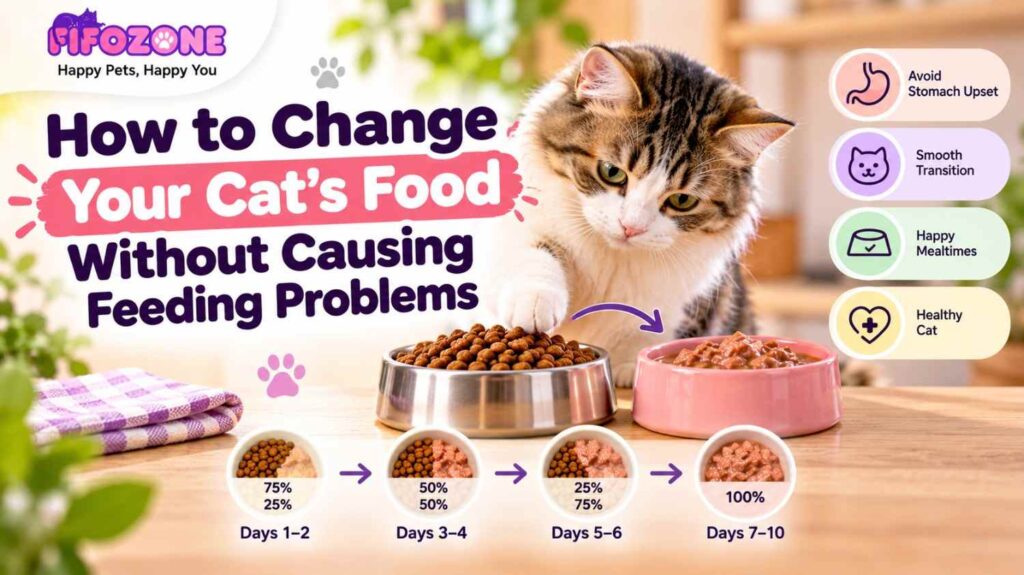
Changing your cat’s food is far easier if you do it gradually rather than just swapping the old food out for the new all at once. A sudden change can result in loose stools, vomiting and/or food refusal in some cats.
A 7-10 day gradual transition is a good starting point although some sensitive cats may require more time. Always follow your vet’s advice if your cat has a medical condition or is on a prescribed diet.
Whether you’re switching cat food brands, moving from dry to wet food or introducing a new recipe, patience is key. You need to monitor your cat’s appetite, stools and behaviour throughout the process and if any problems do arise then you need to slow right down.
How to Change Your Cat’s Food Gradually Without Upsetting Its Stomach
The easiest way to switch cat food is to start by mixing in a small amount of the new food with the old food and then slowly increasing the proportion of the new food over several days. This gives your cat time to get used to the new taste, smell and texture. A typical transition takes 7 to 10 days though some cats do take longer.
Follow this general transition plan:
| Days | Current food | New food |
| Days 1–2 | 75% | 25% |
| Days 3–4 | 50% | 50% |
| Days 5–6 | 25% | 75% |
| Days 7–10 | Gradually phase out | Gradually increase to 100% |
These are just percentages as a practical guide rather than a rigid rule. If your cat starts to have loose stools, vomits or just won’t eat the new food then stop the transition and get veterinary advice if the problem continues or gets worse. Cats with sensitive stomachs or a history of digestive issues may well need a much slower transition.
Why Should You Avoid Changing Your Cat’s Food Overnight?
Changing cat food overnight can be tricky for some cats as the new recipe may have a different mix of ingredients, different fat content, different fibre, different moisture and different texture. Your cat may also just not be used to the smell or the taste. A gradual transition is the best way to work out whether the new food is going to be acceptable and gives you the chance to react if any digestive upsets do occur.
A sudden change won’t cause problems in every cat but it can increase the likelihood of feeding problems. Don’t try to change everything at once (e.g. food brand, meal times and feeding location). The rest of your cat’s routine should be as unchanged as possible so that you can properly assess how it responds to the new food.
How to Choose the Right New Food Before Switching Your Cat’s Diet
Before you change your cat’s food, make sure the new food is complete and balanced for your cat’s life stage and nutritional requirements. Check the feeding instructions, the ingredients and the calorie content and see if the texture is something your cat will accept. If the change is being made for a medical reason then of course consult your vet to find out what diet is appropriate prior to making the switch.
Before buying a new product, check:
- Life stage: Make sure the food is suitable for a kitten, adult or senior cat as stated on the label.
- Nutritional adequacy: Check whether it is a complete food or a complementary product.
- Ingredients and formulation: Compare the information on both food labels.
- Calorie content: Different foods can provide different calories per gram, so portions may need adjusting.
- Feeding instructions: Follow the manufacturer’s guidance and any veterinary recommendations.
For broader guidance on comparing food types and choosing a suitable diet, read Fifozone’s guide to choosing cat food in India.
How to Switch Your Cat From Dry Food to Wet Food or Wet Food to Dry Food
When you’re switching from dry to wet food (or vice versa) you need to introduce the new food in small amounts and progressively increase the proportion. The wet and dry foods will have different moisture contents, different textures and different energy densities so equal amounts by weight may not give you equal energy. Check the feeding instructions for both the dry and the wet food and adjust the total amount you’re feeding accordingly.
Some cats will take to a new texture very quickly, others will take a bit longer to get used to it. You could offer the new food in a separate clean bowl alongside the old food if you find that mixing them causes your cat to reject the whole thing. Don’t leave wet food out any longer than the manufacturer’s recommended time and open food should be refrigerated as per the instructions.
To understand the differences between food types before making the change, read Fifozone’s article on wet vs dry cat food.
What Should You Do If Your Cat Refuses the New Food?
If your cat is refusing the new food then don’t force the change or go in and take away its normal food to make it hungry. Go back to a food it will eat, and then you can consider a more gradual transition once it’s eating properly. You could try a small amount of the new food in a clean bowl in a quiet spot and see how much your cat will actually eat.
Cats can be very sensitive to changes in taste, smell, texture and feeding environment. Keep mealtimes as calm as possible and don’t introduce several new foods at the same time. Never force feed your cat unless a vet has specifically told you how to do so. If your cat is eating very little or stops eating altogether then get in touch with your vet straight away rather than just waiting for it to take to the new diet.
What Are the Signs Your Cat Is Not Adjusting Well to New Food?
During a food transition look out for any change in appetite, vomiting, loose stools, diarrhoea or any odd behaviour. Some mild changes can occur as part of a diet change but if the symptoms persist or get worse they shouldn’t be overlooked. It’s important to note when the new food was introduced, how much your cat ate and when the symptoms started so that your vet can assess the situation.
Pay attention to these signs:
- Repeated vomiting or ongoing diarrhoea.
- Refusing food or eating much less than usual.
- Marked tiredness, weakness or unusual behaviour.
- Blood in the stool or vomit.
- Signs of dehydration or rapid weight loss.
Contact a vet if the symptoms continue or get worse or if they are occurring in conjunction with any other worrying signs. Get veterinary advice promptly if your cat stops eating as a cat that goes without sufficient food can develop quite serious health problems. It’s not necessarily the new food that’s to blame for every symptom as there could be other medical conditions at play.
How Long Does It Take for a Cat to Adjust to New Food?
Many cats can make the switch to a new food in 7-10 days, but there is no one size fits all timeline. A confident eater will probably go on quite quickly, whereas a very fussy cat or one with a sensitive gut may take several weeks. The rate at which you move is going to be very much down to your individual cat and their response and any advice from your vet.
Use the schedule as a guide rather than a deadline. If your cat is eating well and tolerating each stage then proceed as planned. If it refuses the new food or starts to show digestive upset then stop and go back to the previous stage. For cats on a therapeutic or prescription diet you will of course have to follow the vet’s instructions rather than use the schedule.
How to Change Cat Food Safely for Kittens, Senior Cats and Cats With Health Conditions
Kittens, older cats and cats with pre-existing health conditions may require extra care when their food is changed. Their nutritional requirements can be different and some medical conditions will require a specific diet. Always check that the new food is appropriate for your cat’s age and health status and if in any doubt seek your vet’s advice and ask for an individualised transition plan.
Consider these situations:
- Kittens: Choose food formulated for growth and follow age-appropriate feeding guidance.
- Senior cats: Monitor appetite, weight and chewing comfort, particularly if your cat has dental problems.
- Cats with digestive issues: Ask a veterinarian whether a slower transition or a specific diet is appropriate.
- Cats on prescription diets: Do not replace the prescribed food without veterinary guidance.
- Cats with suspected food allergies: Work with a veterinarian; an allergy assessment may require a controlled diet trial rather than trying different foods at random.
If you are changing food because your cat has ongoing symptoms, arrange a veterinary assessment instead of relying on a food switch alone.
When to Change Your Cat’s Food (and When Not To)
Change your cat’s food when their nutritional requirements change, when the current food is no longer suitable, when a product is out of stock or when your vet recommends a different diet. Don’t just switch it on the basis of a new flavour looking good. Don’t change a prescribed diet without your vet’s advice. If your cat is unwell or refusing to eat then you need to work out the reason for this before treating it as just plain food fussiness.
When changing cat food makes sense
There are several situations in which changing your cat’s diet may be appropriate:
- Moving from kitten to adult food: Growing kittens need a diet formulated for their life stage. Discuss the appropriate time to transition with your veterinarian.
- Changing nutritional requirements: Pregnancy, ageing, changes in activity or certain health conditions can affect dietary needs.
- Following veterinary advice: A veterinarian may recommend a specific diet for conditions such as kidney disease, diabetes, food allergies or digestive problems.
- Resolving a genuine feeding issue: Your cat may consistently refuse its current food, or the product may no longer be available.
- Changing food formats: You may want to introduce wet food alongside dry food or move to a different format, provided the diet remains nutritionally appropriate.
Before choosing a replacement, check that the food is complete and balanced for your cat’s life stage. The best option is not necessarily the most expensive product or the one with the most attractive packaging.
When you should delay a routine food switch
It’s best not to make any unnecessary changes to your cat’s diet while she is recovering from illness, going through digestive symptoms or getting used to a major change in her environment. When a diet has been prescribed for a medical condition, you should ask your veterinarian before switching to another one.
Do not think that your cat has simply chosen to eat only certain foods if it suddenly stops eating, since a loss of appetite may be a sign of an underlying medical issue. The Cornell Feline Health Center recommends that a vet should be seen as soon as possible whenever a cat refuses to eat, especially if the refusal continues or is combined with other symptoms.
Practical tip: If your cat is eating well and its current food suits its nutritional needs, there may be no reason to change it. A planned switch should solve a genuine problem or meet a specific need.
Choosing Your Transition Method
A practical first step for the majority of healthy cats is to make the change over a period of about 7 to 10 days; as your cat gets used to the new food, gradually increase its amount and reduce the rate if any digestive symptoms appear or if your cat refuses to eat the food. Although some cats take longer, those on therapeutic diets may need a transition that is directed by a veterinarian rather than following a normal schedule.
Method 1: Gradually mix the old and new food
This method is useful when your cat accepts mixed food and both diets can be safely combined during the transition.
| Transition stage | Old food | New food |
| Days 1–2 | 75% | 25% |
| Days 3–4 | 50% | 50% |
| Days 5–6 | 25% | 75% |
| Days 7–10 | Gradually reduce to 0% | Gradually increase to 100% |
The proportions of the foods in the transition referred to are not necessarily the same in terms of weight or volume when the two products have different calorie densities. You should follow the feeding amounts given for each food.
It is a flexible example and not a deadline; so, if your cat shows only minor digestive changes or becomes unwilling to eat, then go back to the last stage that it tolerated well. If the symptoms continue, get worse or involve repeated vomiting, severe diarrhoea or a loss of appetite, you should obtain veterinary advice.
Method 2: Offer the new food in a separate bowl
Certain cats don’t like having a familiar meal mixed with a new smell or texture; therefore, you should provide a small quantity of the new food in a separate and clean bowl together with the usual food.
This method allows your cat to explore the new food without losing access to its normal meal, especially since it is helpful in cases where cats reject food with a mixed texture or become suspicious of a familiar food when its smell changes.
The World Small Animal Veterinary Association (WSAVA) states that the methods used when assisting an animal in making a transition should be tailored to that animal, and its advice on nutrition also acknowledges that separate food bowls can be useful for cats which reject mixed food.
Method 3: Follow a veterinary transition plan
Cats that have medical conditions, are allergic to certain foods or are on a therapeutic diet may require a different method. It is up to your veterinarian to tell you whether the foods should be mixed, given separately or changed in accordance with a specific schedule.
For instance, if the issue is a possible food allergy, putting treats, toppers or other proteins on during the prescribed elimination diet could interfere with the evaluation. You must follow the vet’s instructions exactly.
Which method should you choose? Start with gradual mixing if your cat accepts it. If mixing causes food refusal, try separate bowls while keeping the familiar food available. For medical diets, follow your veterinarian’s plan.
Go, Hold or Step Back: Reading Your Cat’s Response
Keep increasing the amount of the new food whenever your cat eats its meals normally and shows no signs of concern regarding its digestion or behaviour. Maintain the present ratio if your cat is hesitant or if mild digestive changes occur. If tolerance decreases, then get in touch with a veterinarian if the symptoms persist, if vomiting occurs repeatedly, if there is severe diarrhoea or if the cat refuses to eat.
Go: Your cat is handling the change well
You can usually move to the next transition stage when your cat:
- Eats its usual meals without a major reduction in intake.
- Accepts the new food consistently.
- Passes stools close to its normal pattern.
- Maintains its usual energy and behaviour.
- Shows no repeated vomiting or other concerning symptoms.
Continue observing your cat even when the transition appears successful. A cat may accept a new food initially but become reluctant when the proportion increases.
Hold: Your cat needs more time
You should not automatically increase the amount of the new food simply because that particular day has come.
If your cat is eating but still unsure about the new food or if its stool consistency becomes only slightly different, stop and wait until the situation settles. Make sure the meals remain calm and consistent, provide access to fresh water, and do not introduce more than one new food or treat at a time.
If the problem continues or if you are uncertain as to whether the symptom is significant, it is better to get in touch with your veterinarian rather than carrying on with the transition forever.
Step back: Your cat is not tolerating the change
If your cat becomes more and more unwilling to eat or if its digestive symptoms get worse, go back to the last stage that it tolerated well. This could involve lowering the amount of the new food or once again giving it the usual diet while you look for advice.
If your cat is not well, don’t continue with the experiments. Whenever vomiting occurs repeatedly, there is or is a severe or persistent diarrhoea, the stool contains blood, there is marked lethargy or signs of dehydration, you should get veterinary care as soon as possible.
Important: A cat that stops eating needs particular care. Do not wait for the transition schedule to finish or try to force the new food. Contact your veterinarian promptly for guidance, especially if your cat has an existing medical condition.
A simple decision rule
- Eating normally and acting normally? Continue gradually.
- Hesitant or experiencing mild changes? Hold the current stage and monitor closely.
- Symptoms worsening or food refusal? Step back where appropriate and contact your veterinarian.
- Severe symptoms or a cat that is not eating? Seek veterinary advice promptly.
The aim is not to finish the transition on schedule. It is to move to a suitable diet while keeping your cat eating safely.
Solving Feeding Problems During the Switch
If a cat refuses to eat the new food, eats less than usual or shows digestive problems, rather than pushing the transition, you should pause it. Make sure that the food is fresh, that the temperature at which it is served is appropriate, that the food bowl is clean and that the place where it is being fed is suitable. Give the usual food if this is appropriate and if the symptoms continue, get worse or include a loss of appetite, then contact a veterinarian. Do not use hunger as a way of getting your cat to accept a new diet.
Problem: Your cat refuses the new food
Cats can be sensitive to differences in aroma, texture, shape and temperature. A new recipe may smell unfamiliar even if its nutritional profile is suitable.
Try these steps:
- Offer a small amount of the new food in a clean, separate bowl.
- Keep the familiar food available so your cat does not have to choose between eating and accepting the new diet.
- Serve food at a suitable temperature. Wet food taken from the refrigerator may be less appealing when very cold; bring it to a safe, comfortable serving temperature.
- Feed your cat in a quiet area away from litter trays, noisy appliances and other pets.
- Check the package’s expiry date, storage instructions and the food’s appearance and smell.
Avoid repeatedly changing brands, flavours and toppers in the same meal. Making several changes at once can make it harder to understand what your cat accepts and may create further feeding difficulties.
Never deliberately starve a cat into accepting a new food. If your cat stops eating, contact a veterinarian promptly rather than waiting several days to see whether hunger changes its preference.
Problem: Your cat develops soft stools or diarrhoea
A change in diet may lead to digestive trouble, but it doesn’t follow that every instance of diarrhoea is due to the new food.
When the symptoms are mild, stop the process and get in touch with your veterinarian if they continue or come back.
Do not raise the amount of the new food while your cat is having difficulty tolerating it. Obtain urgent treatment if there is severe diarrhoea, blood in the stool, repeated vomiting, weakness or signs of dehydration.
Kittens, older cats and those cats with existing health conditions should be subject to a more careful evaluation.
Problem: Your cat vomits after eating
A single episode may have several causes, including eating quickly, but repeated vomiting should not be dismissed as a normal part of changing food.
Stop progressing through the transition and seek veterinary advice. Repeated vomiting, an inability to keep water down, marked lethargy or other severe symptoms require urgent assessment.
Problem: Your cat eats less than usual
Check the amount of food given and the amount that is left. A cat which seems to eat only a few bites might in fact be eating considerably less than its normal amount.
If your cat stops eating or the amount of food it eats greatly decreases, you should quickly get in touch with your veterinarian. Do not continue to give it treats or human food in order to make up for the situation without first understanding the reason.
Problem: Your cat accepts the new food, then rejects it
Check whether the food has become stale, whether the serving routine has changed and whether another pet is interfering with mealtimes. If the food is fresh and the refusal continues, return to the last successful step and discuss the issue with your veterinarian if necessary.
The key principle: Food refusal and digestive symptoms are signals to assess, not behaviours to punish. A successful food transition should preserve adequate intake and your cat’s wellbeing.
Safe Toppers vs Foods to Avoid
A little bit of a known food that is safe for cats might encourage some cats to try a new diet, but toppers should not be used as a substitute for a complete and balanced meal. They should only be given if they are suitable for your cat and its prescribed diet. It is important to avoid ingredients which are toxic, seasoned left-overs, raw animal products and too many treats. In the case where your cat is on an elimination or therapeutic diet, you should consult your veterinarian before making any additions.
Can toppers help a cat accept new food?
A topper is a small addition placed on or beside a cat’s usual meal. Depending on the cat, a small amount of its familiar wet food or a veterinarian-approved option may make the new food more appealing.
However, toppers are not essential. Some cats prefer to investigate a new food separately, and mixing it into a familiar meal can cause them to reject the entire serving.
Use these guidelines:
- Introduce only one topper at a time.
- Keep the quantity small and account for its calories.
- Choose plain, unseasoned ingredients only when they are known to be safe for your cat.
- Do not use toppers if they conflict with a prescribed diet or food-allergy trial.
- Remove uneaten wet food according to safe food-handling guidance rather than leaving it out for extended periods.
Treats and extra foods should continue to form only a small portion of the cat’s total diet. According to Cornell’s Feline Health Center, treats should usually make up no more than 10 to 15 per cent of a cat’s daily calorie intake; in some cases, particularly with cats being fed medical diets, more strict limitations may be necessary.
Foods and ingredients to avoid
Do not use the following to persuade your cat to eat a new diet:
- Onion and garlic: These can damage cats’ red blood cells.
- Chocolate and caffeinated products: These can be toxic.
- Alcohol: Never offer alcoholic drinks or foods containing alcohol.
- Raw meat or raw eggs: These can carry harmful pathogens and are not a risk-free feeding option.
- Heavily salted, spicy or oily leftovers: These are unsuitable as routine cat food and may contain unsafe ingredients.
- Milk and dairy products as a routine topper: Many cats have difficulty digesting lactose.
- Dog food as a replacement for cat food: It is not formulated to meet a cat’s nutritional requirements.
- Human canned fish as a complete meal: It is not a nutritionally complete substitute for cat food and may contain added salt or other ingredients.
Never add seasoning, sauces or stock cubes to make food more appealing. Check every ingredient, especially when using food prepared for people.
Why a complete and balanced diet matters
It is not advisable for toppers to replace the food which supplies the nutrients your cat requires. You should select a commercially available diet that is labelled as complete and balanced for the correct life stage, or use a home-prepared diet that has been formulated for your cat by a qualified veterinary nutritionist.
If you suspect that your cat has a food allergy or if it needs a therapeutic diet, you should ask your veterinarian before introducing any additional ingredient, since even a small amount can spoil a carefully controlled feeding plan.
Calories, Portions and Weight During the Switch
When you are switching your cat’s food, rather than simply replacing the same amount of grams, you should compare the calorie content of the old food with that of the new one since different foods have different calories per gram, particularly dry and wet food. You should follow the feeding instructions for your cat, measure out the portions consistently and keep an eye on its weight and body condition. If necessary, ask your veterinarian to establish a personal calorie target.
Why equal portions may not mean equal calories
The energy content of one portion of a food whether measured in a cup, a scoop or in grams can be different from that of the same amount of another food. This is because dry food is usually more calorie-dense than wet food since it has less moisture.
It is important when you change brands, when you move from a wet to a dry food or when you use both types. If you just replace the old food in equal grams, your cat might end up with too many or too few calories.
Look on the packaging for the energy content, which is generally given in kcal per kilogram, kcal per 100 grams or kcal per serving. Take the manufacturer’s feeding instructions as a basis and then make any necessary adjustments based on your cat’s specific requirements and according to advice from your vet.
How to calculate the new portion
If you know your cat’s appropriate daily calorie target and the food’s calorie content, you can estimate the daily amount.
For food labelled in kcal per 100 grams:
Daily grams = daily calorie target ÷ kcal per 100 g × 100
For example, if a veterinarian has set a daily target of 200 kcal and a food provides 100 kcal per 100 g, the calculation is:
200 ÷ 100 × 100 = 200 g per day
This is a mathematical example, not a feeding recommendation for every cat. The correct calorie target depends on factors such as body weight, age, activity, neuter status, body condition and health.
If the old and new foods have different calorie densities, calculate their portions separately during the transition. Do not assume that a 50:50 mix by weight automatically supplies half the calories from each food.
Monitor weight and body condition
During the transition:
- Measure food rather than estimating by eye.
- Record how much your cat actually eats.
- Keep treats and toppers in the daily calorie total.
- Weigh your cat periodically using a consistent method.
- Watch for changes in body shape, energy and appetite.
- Consult your veterinarian if weight changes unexpectedly.
Do not start a rapid weight-loss diet or sharply reduce food during a routine transition without professional guidance. Overweight cats may need a structured weight-management plan, while unexplained weight loss should be investigated.
Switching Food in Indian Conditions
In India, when changing a cat’s food it is necessary to select an appropriate complete diet, to store it properly in warm or humid conditions and to follow the same principle of gradual transition as is done in other places. You should check the expiry dates, the condition of the packaging and the storage instructions, and after opening keep the wet food in the refrigerator as instructed. It is never advisable to leave wet food exposed to heat for long periods or to use any food that looks spoiled.
Choose a suitable food, not just a popular brand
Cat owners in India have access to a wide variety of brands, pack sizes and products which are either imported or available locally. Before making the change, it is necessary to verify that the food is complete and balanced for your cat’s life stage and that it meets any specific health requirements.
Check the feeding instructions, the nutritional information, the expiry date and the storage requirements. When the food is marketed for a specific medical condition, it is necessary to consult a veterinarian before using it for the management of that condition.
Price and availability are also important; so if a certain product is hard to find regularly, it would be a good idea to talk to your veterinarian about a suitable and reliably available alternative before the current food is used up.
Store food carefully in warm and humid weather
Heat, humidity and poor storage can affect food freshness. Follow the manufacturer’s directions, including any instructions about refrigeration after opening.
- Store dry food in a cool, dry place away from direct sunlight.
- Keep it in its original packaging when practical, with the packaging securely closed; if using an airtight container, keep the original label and expiry details.
- Do not use food past its expiry date or food with damaged packaging, unusual odour, visible mould or signs of contamination.
- Refrigerate wet food according to the label and serve it at a comfortable temperature.
- Discard food that has been left out too long, particularly in warm conditions, following the manufacturer’s food-safety guidance.
- Wash and dry food bowls regularly.
Avoid buying a very large bag simply because it offers a lower price per kilogram if your cat will take a long time to finish it or the food cannot be stored properly after opening.
Make the transition practical for your household
If you buy cat food online, you should order the replacement well in advance so that you can carry out a gradual transition and still have some of the usual food available. Make sure you note the current food’s name, flavour, life stage formulation and the amount to be fed in order that you may find an appropriate substitute should this food become unavailable.
When launching a new texture or a new brand, do not alter the food, the feeding times and the bowl position at the same time; by keeping all the other parts of the routine unchanged you will find it easier to determine what your cat does or does not tolerate.
At Fifozone, people who have cats are able to look at the different types of cat food and compare the products based on the requirements of their cats. It is important to check before making any change whether the product is suitable and what the feeding instructions are.
Final Checklist: Changing Your Cat’s Food Step by Step
To change your cat’s food safely, choose a suitable replacement, check whether veterinary advice is needed, and introduce the new food gradually. Monitor appetite, stools, vomiting, behaviour and weight. Pause or step back if tolerance worsens, and contact a veterinarian for persistent symptoms or food refusal. Do not force the transition or allow your cat to go without adequate nutrition.
Before you start
- Confirm that the new food suits your cat’s age and nutritional needs.
- Speak to your veterinarian if your cat has a medical condition, food allergy or prescribed diet.
- Check the new food’s expiry date, packaging and storage instructions.
- Buy enough of the current food to make a gradual transition practical.
- Decide how you will measure portions and monitor appetite.
During the transition
- Begin with a small proportion of new food.
- Increase the proportion gradually if your cat tolerates it.
- Offer separate bowls if your cat rejects mixed food.
- Keep fresh water available.
- Avoid adding multiple new foods, treats or toppers at the same time.
- Record changes in appetite, stool consistency, vomiting and behaviour.
- Adjust the pace to your cat rather than following the calendar rigidly.
After the transition
- Confirm that your cat is eating the new food consistently.
- Check that the daily portion matches the food’s calorie content and your cat’s needs.
- Continue monitoring weight, body condition and digestion.
- Store the food according to the package instructions.
- Contact your veterinarian if symptoms develop, persist or recur.
Frequently Asked Questions
How many days should it take to change a cat’s food?
A gradual change usually lasts between 7 and 10 days, beginning with a small quantity of the new food and then increasing the amount over time. In some cases cats require a longer period, particularly if they are picky eaters or have a sensitive digestion. If your cat shows signs of discomfort, reduce the amount and adhere to your veterinarian’s recommendations when a medical diet is being used.
Can I switch my cat’s food without mixing the old and new food?
It is a common practice to mix the foods so that the change takes place gradually, although some cats would rather have them served in separate bowls. The key thing to do is to carefully introduce the new food and ensure that your cat still eats enough. If your cat refuses to eat or if it needs a prescribed diet, you should ask your veterinarian for advice.
What should I do if my cat gets diarrhoea after changing food?
If the diarrhoea continues, gets worse or is accompanied by vomiting, weakness, blood in the stool or a decreased appetite, stop the transition and get in touch with your vet. Although the symptoms might be due to the change, there are other possible causes as well. Do not administer any human medicines or keep increasing the new food without first obtaining proper advice.
Why does my cat refuse new food even when it is good quality?
Cats can stop eating if the food smells, tastes or feels different from what they are used to; a change in where they are fed or in their feeding routine may also have an effect on their eating. Give them a small quantity in a clean and quiet environment and carry out the change slowly. However, if your cat refuses to eat or only eats much less than normal, you should get professional veterinary advice.
Can I change my cat’s food brand directly?
When changing brands it is generally advisable to make the transition slowly since different recipes can differ in their ingredients, texture and calorie content. You should compare the feeding instructions and introduce the new food over a number of days. However, if the change is urgent or the new food has been prescribed, you should ask your veterinarian for advice on how to make the switch safely.
Should I change my cat’s food if it has a sensitive stomach?
The fact that your cat has a sensitive stomach doesn’t mean that it needs to be fed a different type of food. If your cat is experiencing frequent vomiting, diarrhoea or other digestive problems, you should consult your veterinarian before making any change to its diet. The vet will be able to help work out possible causes and will be able to suggest an appropriate food as well as a suitable plan for changing its diet if a change is necessary.
When should I contact a veterinarian during a food transition?
If your cat is vomiting repeatedly, has ongoing diarrhoea, won’t eat, loses weight or behaves in an unusual way, then you should contact a veterinarian. If your cat stops eating, you should get professional advice as soon as possible, particularly if it already has a health problem. Don’t wait until the transition schedule has ended when your cat is showing signs that are of concern.


Leave a Comment & Share Your Advice
Your experience can help other pet parents!
Top Comments