
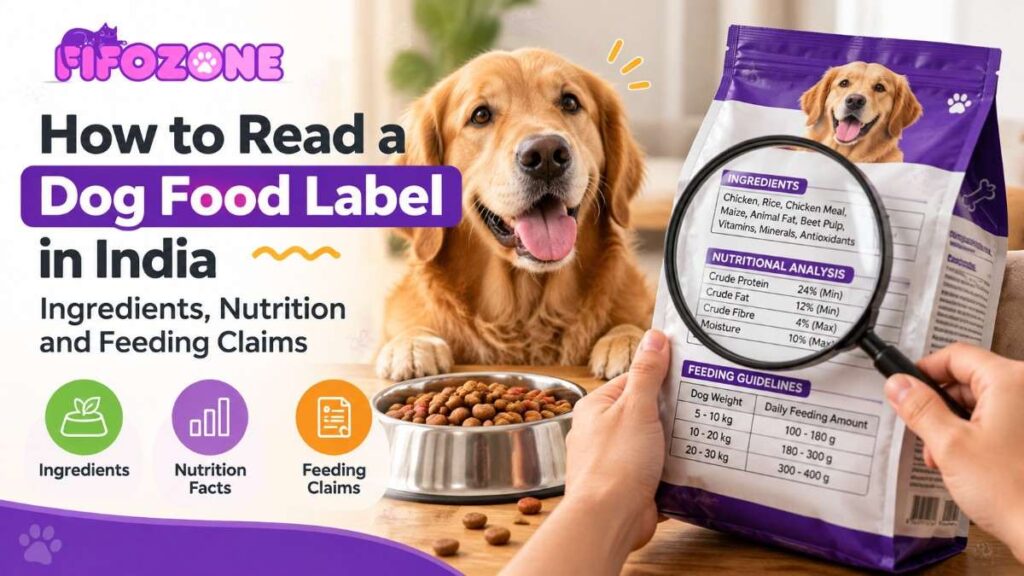
Choosing a dog food is a lot easier if you know how to read the label beyond the name and the claims on the front. The label will contain information on the ingredients, the nutrient levels, the feeding instructions and the intended use of the product. That information enables you to compare the products more properly and make a much more informed choice regarding your dog’s daily nutrition.
When comparing dog food options, look beyond the product name and advertised benefits. Check the ingredient list, nutritional analysis, feeding instructions, and nutritional adequacy statement to understand what the product offers. For a more detailed explanation, read our guide on how to read a dog food label in India.
Why Reading a Dog Food Label Matters
A dog food label is there to tell you what’s in the food, how to feed it and whether or not it’s a complete diet. The front of the pack might point out some of the ingredients or benefits, but the actual ingredient list and the nutritional information are the real deal. You get a far better idea of what you’re buying by reading both sides of the pack.
When checking a dog food label, look at these details first:
- Ingredient list and order
- Guaranteed analysis or declared nutrient levels
- Nutritional adequacy and intended life stage
- Calorie information, when available
- Feeding instructions
- Manufacturer or distributor details
How to Read the Ingredient List on Dog Food
The ingredients list will show the ingredients used in the product (usually in order of weight at the time of formulation). The first few ingredients will tell you which ingredients are used in the greatest quantities, but they won’t tell you the actual nutritional value of the finished product. You have to read the full list to get a true picture of the product.
Does the First Ingredient Always Mean Better Quality?
No. The first ingredient isn’t the thing that tells you whether one dog food is better than another. Fresh meat is 90% water so its position in the ingredient list doesn’t tell you anything about the amount of protein in the final dry food. You need to look at the full recipe, the nutrient analysis, the nutritional adequacy statement and what the manufacturer has to say.
What Do Meat Meals, Grains and By-Products Mean?
Ingredient names are just that, they describe the different materials that go into a recipe and the nutritional value of the ingredient will vary according to the ingredient and how it has been processed. Meat meals are a very concentrated ingredient with a lot of the water removed. Grains can provide energy and other nutrients. By-products can also provide some nutrients. Don’t judge the ingredients by their names alone, you need to look at the full formulation and product information.
Should You Avoid Artificial Colours, Preservatives or Fillers?
Don’t just toss dog food out because some ingredient sounds odd or is described as a filler on the internet. Ingredients have different functions, they can be there to provide nutrients, to help with product stability and to aid in the manufacturing process. It’s important to understand why an ingredient is included and whether the manufacturer gives a reason for it. If your dog has a diagnosed food allergy or dietary requirement then of course you’ll want to ask your vet which ingredients you need to avoid.
How to Understand Guaranteed Analysis on Dog Food Labels
Guaranteed analysis will list the levels of certain nutrients (typically crude protein, crude fat, crude fibre and moisture). Depending on the label and the applicable regulations, further nutrients may also be listed. The figures are useful for comparison purposes but don’t give you the full story. To interpret the figures properly you need to know whether each one is a minimum, a maximum or some other type of declared value.
| Label term | What it tells you |
| Crude protein | The declared protein level, not a direct measure of protein quality |
| Crude fat | The declared fat level, which contributes energy and essential fatty acids |
| Crude fibre | A measure related to the less digestible fibre portion |
| Moisture | The amount of water in the food |
| Ash, if listed | An estimate of the total mineral residue after analysis |
The word crude refers to the analytical method used to measure the nutrient category. It does not mean the protein or fat is poor quality.
What Is the Difference Between Minimum and Maximum Values?
A minimum value means the nutrient level should be at least that amount, a maximum value means it should not be more than that amount (under the relevant labelling rules). The guarantee is not necessarily that the amount will be precisely that in every batch. So a minimum protein guarantee of 24% doesn’t mean the product will contain exactly 24% protein.
How to Compare Dry Dog Food and Wet Dog Food Fairly
Dry and wet dog food have very different water contents so you can’t simply compare their protein levels. Dry food will have far less water than wet food. A dry matter comparison is the way to go in this situation as it allows for a fair comparison of the actual nutrient content of the two types of food.
Use this formula:
Dry-matter percentage = nutrient percentage ÷ (100 − moisture percentage) × 100
For example, consider two illustrative products:
| Nutrient | Dry food | Wet food |
| Protein as sold | 26% | 10% |
| Moisture | 10% | 75% |
| Protein on a dry-matter basis | 28.90% | 40% |
In this example, the wet food has a higher protein percentage on a dry-matter basis, even though its label shows a lower protein percentage as sold. This comparison explains the moisture difference; it does not establish which food is more suitable for a particular dog.
How to Check Whether Dog Food Is Complete and Balanced
Look for a statement as to whether the dog food is intended to provide complete nutrition or is simply for complementary/intermittent feeding. A product that is labelled for complementary or intermittent feeding should not be assumed to be the main diet. Check the stated purpose, the life stage it’s for and the nutritional content and if in any doubt ask the manufacturer or your vet.
What Does “Complete and Balanced” Mean on Dog Food?
“Complete and balanced” usually means the food is formulated to provide the nutrients required in the right amounts and proportions for its intended purpose. The precise definition and the relevant standard will vary by market and product. It’s worth looking at the nutritional adequacy information and the basis for the claim rather than just accepting the phrase on the pack.
Why the Intended Life Stage Matters
Dog foods can be formulated for a range of life stages (growth, adult maintenance etc). A food formulated for adult maintenance may not be the right food for a growing puppy. Always check the life stage information on the label and seek veterinary advice if your dog has any specific nutritional requirements. This article is about reading the label, not about choosing a food based on age or size.
How to Understand Dog Food Feeding Instructions and Calorie Information
Feeding guidelines give you a starting point as to how much to feed, the calorie content will tell you how much energy that portion contains. The amount suggested is not necessarily the correct amount for every dog. You should read the instructions in conjunction with your dog’s current diet and treats and if at all unsure as to the correct daily amount then seek advice from your vet.
How to Read the Feeding Guide on a Dog Food Pack
Feeding tables will usually use body weight (and occasionally life stage or activity level) as a guide to the amount to feed per day. Check whether the amount suggested is for the whole day or for each meal. Measure your portions consistently and be prepared to modify them as required with the advice of your vet. Don’t treat the feeding table as an exact rule for every dog.
Why Calories Matter When Comparing Dog Food
Calories are a measure of the energy that a food provides. Two products can have the same guaranteed % protein and the same guaranteed % fat and yet have very different calorie values. If calorie information is given, check that it is on a per kg, per serving or some other basis and compare like with like. If it isn’t provided then the manufacturer may be able to provide it.
What Do “Natural,” “Grain-Free” and Other Dog Food Claims Mean?
Terms like ‘natural”, ‘premium”, “grain free” and “high protein” will grab your attention, but they don’t tell you anything about the actual nutritional content. You have to look at the full label and see what the claim actually means in that particular food. A marketing term in itself will not tell you that the food is complete, balanced and appropriate for all dogs.
Is Grain-Free Dog Food Always Better?
No, grain free dog food isn’t automatically better than grain containing food. It’s the overall nutritional make up of the recipe that matters and your dog’s individual requirements. Grain free products can be based on other carbohydrate sources such as potatoes and legumes. If you’re at all suspecting a food allergy or intolerance then you should see your vet rather than simply switching to a grain free diet based on the label.
What Does “High Protein” Mean on a Dog Food Label?
A “high protein” claim must be considered in the context of the actual protein content (as declared), the calorie content and the overall nutritional profile. Products need to be compared on the same basis (particularly where one is a dry product and one is a wet product). The protein percentage alone will not tell you anything about protein digestibility, amino acid balance or whether the complete diet is going to meet your dog’s nutritional needs.
Are Marketing Claims Proof of Better Nutrition?
No. Claims like ‘premium”, “natural “” or” vet recommended” shouldn’t in any way substitute for a proper look at the label and the associated information. You need to be able to see what the product actually is and have a manufacturer that can give you details on the formulation, quality control and nutritional adequacy. The best information is the information that’s reliable rather than the information that’s just on the pack in large quantities.
What to Check About the Dog Food Manufacturer
The manufacturer/distributor details will tell you who the product is from and who you can contact if you have any questions. A reputable company will be able to explain its nutritional claims, its quality control and its feeding advice. If the information is missing or the manufacturer can’t answer the most basic of questions then that should be a red flag and you should look for more information before you buy.
Before making a decision, check whether the label or manufacturer provides:
- A clear product name and intended animal
- Ingredient and nutrient information
- Feeding and storage instructions
- Manufacturer or distributor contact details
- Information supporting nutritional adequacy claims
Labelling requirements vary between countries and product types, so do not assume that every international label uses the same wording or standard.
A Simple Checklist for Reading Dog Food Labels
Before you buy a dog food product look at the whole label rather than just the one headline ingredient or marketing claim. Look at the ingredients, the nutrient declarations, the intended use and the feeding instructions. If anything is missing or unclear then get in touch with the manufacturer or see your vet. That one simple check will go a long way to enabling a more fair comparison and will prevent you from making assumptions based on the packaging.
- Confirm that the product is intended for dogs.
- Read the full ingredient list.
- Check the guaranteed analysis or declared nutrient levels.
- Review the complete-and-balanced or complementary-feeding statement.
- Check the intended life stage.
- Compare calorie information and feeding instructions where available.
- Review manufacturer details and product claims.
At Fifozone, you can use these label-reading tips when reviewing product information before making a purchase. If you need help with a dog’s specific health or dietary needs, seek advice from a qualified veterinarian.
Anatomy of an Indian Dog Food Pack
An Indian dog food pack will typically have the product name, brand, type of food and key claims on the front panel. The back or sides will have more detail (ingredients, nutrient values, feeding instructions, net quantity, manufacturer details, batch number, dates and storage instructions etc). Always check the whole pack before you buy, not just the front.
Where to Look on the Pack
| Label area | What to check |
| Front panel | Product name, intended animal, food type and marketing claims |
| Ingredient list | Ingredients used in the recipe |
| Nutritional information | Declared nutrient levels and calorie details, where provided |
| Feeding directions | Suggested daily quantity and feeding instructions |
| Product details | Manufacturer or importer information, batch code and dates |
| Storage instructions | How to store the product before and after opening |
Not every product has the same layout. Dry kibble, wet food, treats and supplements can have different label information because they serve different purposes. If a detail is printed in small text, check the back panel, side seam or attached label rather than relying on the front design.
What Is Mandatory on Indian Labels and What Isn’t?
The info that’s required on a dog food label will vary depending on the product and the rules that apply to it. You can’t just assume that everything that’s required on a package of human food is also required on a package of pet food. A good way to check is to see if there’s clear product identification, ingredient and nutritional information (where available), the manufacturer can be traced, there’s batch and date information and there are directions for safe use.
Which Label Details Should You Check?
Before buying dog food in India, look for:
- Product identity: Does the packaging clearly identify the product and its intended animal?
- Ingredients and nutrition: Are the recipe and declared nutrient details readable?
- Traceability: Can you identify the manufacturer, importer or responsible business?
- Batch and dates: Can you identify the batch and check the product’s date information?
- Use and storage: Are feeding directions, precautions and storage instructions available where relevant?
The Bureau of Indian Standards has published a standard for dog feeds, IS 11968. However, do not assume that every provision of a standard is legally compulsory for every product. Verify the current standard, its applicability and any relevant legal requirements before treating a particular label detail as mandatory.
What Is the Difference Between a Legal Requirement and Good Practice?
A legal requirement is an obligation that applies under the relevant law or standard. Good practice is additional information that helps buyers make informed decisions, such as clear calorie information, easy-to-understand ingredient descriptions or detailed quality-control information. A label may be useful even when it does not contain every detail a buyer would like to see.
Ingredient Glossary: Common Terms on Indian Dog Food Labels
Dog food labels can contain names which are quite unfamiliar to a lot of people. Terms like meat meal, animal fat, cereal grains, by-products, vitamins and minerals are all descriptions of ingredients or groups of ingredients. The name on the label doesn’t in itself tell you anything about the actual nutritional value. You have to look at the full list of ingredients and then evaluate that in conjunction with the nutrient analysis and the purpose of the product.
Common Ingredients and What They Mean
| Label term | What it generally means |
| Chicken or other named meat | An animal-derived ingredient identified by its source |
| Meat meal | A processed animal ingredient with much of its moisture removed |
| Animal fat | Fat from an animal source; check whether the source is specified |
| Rice, maize or other grains | Ingredients that can provide energy and other nutrients |
| Beet pulp or other fibre sources | Ingredients that may contribute dietary fibre |
| Vitamins and minerals | Nutrients added to help meet the food’s nutritional formulation |
| Preservatives | Substances used to help maintain product quality during storage |
Does the First Ingredient Tell You Everything?
No. Ingredients are typically listed by weight at the time of addition where that labelling practice is in place. An ingredient with a higher water content may appear higher in the list than a more concentrated dry ingredient. The list won’t contain the exact % of each ingredient unless that is separately stated. It should be used in conjunction with the nutrient information rather than being used as the sole basis for judging quality.
For a more in-depth explanation of ingredient order and nutrient values, link this section to the main Guaranteed Analysis and Ingredient List guide in the article. This glossary is about explaining the terms used on the label, not about rehashing the full nutritional comparison.
Decoding the Product Name
The product name can be used to highlight an ingredient, a flavour, a food type or the intended purpose of the product. It should be cross checked against the information elsewhere on the pack. “Chicken recipe” for example, by itself doesn’t tell you the exact % of chicken and doesn’t necessarily mean that the product is a more nutritious version of another recipe.
How to Read Common Product Descriptions
- “Chicken flavour” describes a flavour claim; it does not necessarily mean chicken is the main ingredient.
- “With chicken” highlights an ingredient, but the wording alone does not reveal its full proportion.
- “Puppy food” or “adult dog food” identifies the stated life-stage use; check the nutritional information as well.
- “Complete food” indicates an intended role as a main diet, but check the product’s supporting nutritional statement.
- “Grain-free” means the recipe is made without grains; it does not automatically make the food better.
These examples explain common wording, not a universal legal definition for every label sold in India. The meaning and rules for product names can vary by market and claim. When the wording is unclear, check the ingredient list and ask the manufacturer for clarification rather than guessing from the front panel.
Preservatives, Colours and Additives
Preservatives, colours and other additives can be used for all sorts of reasons in dog food (to maintain freshness, to assist in processing, to improve appearance etc). Their presence in a product doesn’t in itself mean that the product is unsafe and a “natural” claim in no way guarantees that it is superior. You need to look at the ingredients list, the function of the additive and the manufacturer’s product information.
What to Check on the Label
- Preservatives: Look for the name of the substance used, where declared, and follow storage instructions.
- Colours: Check whether colour is relevant to the product’s purpose; appearance alone does not establish nutritional value.
- Antioxidants: These may help protect fats from oxidation during storage.
- Added vitamins and minerals: These can form part of a product’s nutritional formulation.
- Other additives: Ask the manufacturer about an unfamiliar ingredient if its purpose or identity is unclear.
Avoid assuming that every synthetic additive is harmful or that every plant-derived additive is harmless. Safety depends on the substance, amount, intended use and applicable standards. If your dog has a known sensitivity or a veterinarian has recommended avoiding a specific ingredient, check the label carefully and seek advice before switching foods.
Batch, Expiry, Storage and Authenticity
Batch codes, date information and storage instructions all help you to check a dog food prior to purchase and to store it correctly once it’s opened. You should be able to see all the details on the bag, container or label. Products with missing or illegible identification, damaged packaging, signs of moisture or an oddity between the printed dates and the product on the list should be avoided.
How to Check These Details
| Detail | What to do |
| Batch or lot code | Check that it is present and readable where provided |
| Manufacturing or packing date | Read the printed date and its format |
| Expiry or best-before information | Check the wording and date; do not treat the terms as identical in every context |
| Seal and packaging | Look for tears, leaks, tampering or moisture damage |
| Storage instructions | Follow the stated conditions, including instructions after opening |
| Authenticity | Buy from a reliable seller and contact the brand if the packaging seems suspicious |
Store dry dog food in a cool, dry place (away from direct sunlight and moisture). Reseal the original bag or use a clean suitable airtight container and keep the batch and date on the container. For wet food, follow the label instructions as regards refrigeration and post-opening. If in any doubt as to the authenticity or condition of a product don’t feed it to your dog and get in touch with the seller or manufacturer.
Label Red Flags and Common Myths
A dog food label warrants a closer inspection if key information is missing, hard to read or inconsistent from one pack to the next. Strong claims in no way compensate for the absence of ingredient and nutritional information. Always check the full label, the product’s stated use and the manufacturer details before you buy and if a claim can’t be properly explained then you should seek clarification.
Common Myths to Avoid
- Myth: The first ingredient is always the best indicator of quality.
Reality: Ingredient order is only one part of the label and does not show the full nutrient profile. - Myth: Grain-free always means healthier.
Reality: Suitability depends on the complete formulation and the individual dog’s needs. - Myth: A high-protein percentage proves superior nutrition.
Reality: Protein percentage alone does not show protein quality, digestibility or overall dietary balance. - Myth: “Natural” means additive-free.
Reality: The term does not automatically mean a product contains no additives or preservatives. - Myth: A premium-looking pack guarantees quality.
Reality: Packaging design is not evidence of nutritional adequacy or manufacturing quality.
Warning Signs Worth Checking
Be cautious if the label doesn’t have a clear product identification, if the dates are illegible, if the seal is damaged, if it makes all sorts of vague medical claims or if there’s no way at all of working out who the product is from. One such ambiguity doesn’t necessarily mean the product is unsafe, but it is a valid reason to hesitate and to question before you buy.
Worked Example: Comparing Two Dog Food Labels
A sensible dog food label comparison looks at the ingredients, the nutrient values, the moisture content, the intended use and the supporting information all in one go. The example below uses completely fictional products to illustrate how you would interpret the figures on the label; it is not in any way a comparison of real products and does not represent any recommendation of one recipe over another. Always use the actual information from the labels of the products you are comparing.
Example Comparison
| Label detail | Product A: Dry food | Product B: Wet food |
| Crude protein as sold | 26% | 10% |
| Crude fat as sold | 14% | 5% |
| Moisture | 10% | 75% |
| Ingredient list | Review actual order | Review actual order |
| Intended use | Check the pack | Check the pack |
| Calorie information | Check the pack | Check the pack |
At first glance, Product A appears to contain more protein because its label shows 26%, compared with 10% for Product B. However, Product B contains much more moisture, so the two figures cannot be compared fairly without accounting for water.
Compare Protein on a Dry-Matter Basis
To account for moisture, use this calculation:
Dry-matter protein = protein as sold ÷ (100 − moisture percentage) × 100
- Product A: 26 ÷ (100 − 10) × 100 = 28.9% protein on a dry-matter basis
- Product B: 10 ÷ (100 − 75) × 100 = 40% protein on a dry-matter basis
In this fictional example, Product B has a higher protein percentage after adjusting for moisture. That does not automatically make it the better food: the ingredient list, full nutrient profile, calorie content, nutritional adequacy and intended use still matter.
What Should You Compare Before Deciding?
Use this checklist when comparing two actual products:
- Confirm that both products are intended for the same animal and relevant feeding purpose.
- Compare the ingredient lists without assuming the first ingredient determines quality.
- Account for moisture when comparing nutrient percentages between dry and wet food.
- Check calorie information and the nutritional adequacy statement, where available.
- Review batch details, dates, storage directions and manufacturer information.
Frequently Asked Questions
1. What should I check first on a dog food label?
Start with the animal (intended use), the nutritional adequacy statement, the ingredient list and the guaranteed analysis. Then go on to the feeding directions, the calorie information and the manufacturer details. That’s the only way you’re going to get a real understanding of the product. The name on the front and the claims on the front are very misleading in that respect.
2. Does the first ingredient on a dog food label matter most?
The first ingredient is the one present in the greatest amount by weight at the point specified by the labelling method. It doesn’t necessarily mean it’s the most nutritious or that it will be the predominant protein in the final product. You need to look at the full ingredient list and the full nutrient information together.
3. What does crude protein mean on a dog food label?
Crude protein is just a measured estimate of the protein content of the food. It tells you nothing about protein digestibility, amino acid profile or overall protein quality. You can use the declared percentage as one element of your comparison but it should by no means be the sole criterion for assessing the value of a food.
4. How do I compare protein in dry and wet dog food?
Check the moisture % and convert the protein figure to a dry matter basis if you’re making a direct comparison. Wet food has a lot more water in it so the protein % as sold will appear lower. You can adjust for this by working out the protein on a dry matter basis, but that doesn’t in any way tell you which of the foods is the best for your dog.
5. What does complete and balanced dog food mean?
It means the product is formulated to provide the nutrients required for its stated purpose when fed as directed. You need to check the nutritional adequacy statement and the basis for that claim. Treats and complementary foods are not necessarily intended to be the complete daily diet for the animal.
6. Is grain-free dog food better for dogs?
Not in the least. Grain free just means the recipe doesn’t contain grains. It doesn’t necessarily mean it’s any better for your dog or that it’s the right choice for your dog. If your dog is known to have food sensitivities or digestive issues then of course you’d want to talk to your vet before going down the route of a special diet.
7. Should I follow the feeding amount printed on the pack exactly?
Use the label’s feeding guide as a starting point rather than as a set in stone. Your dog’s requirements may be different from the guide and of course treats will add to the calories. Measure your portions consistently and if you’re at all in doubt as to how much to feed per day then it’s always worth consulting your vet.


Leave a Comment & Share Your Advice
Your experience can help other pet parents!
Top Comments