
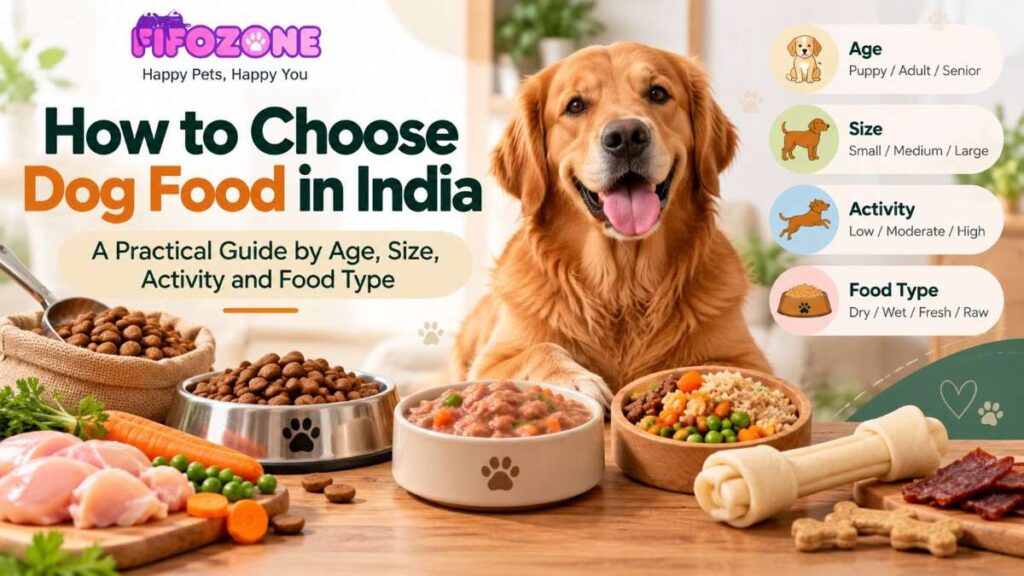
Choosing the right dog food in India depends on your dog’s age, expected adult size, activity level, health and nutritional needs. Puppies need food formulated for growth, while adult dogs generally need a balanced diet for maintenance. The best choice is a complete and balanced food suitable for your dog, with portions adjusted to maintain a healthy body condition.
With so many dry foods, wet foods, breed-specific formulas and high-protein options available, it can be difficult to know which one to choose. This guide explains what to look for, how to compare food options and which factors matter most before buying.
How to Choose the Right Dog Food for Your Dog
To choose the right dog food, start with your dog’s life stage, size, activity level and health needs. Then check whether the food is complete and balanced for that stage, review the feeding directions and compare its nutritional information. Do not choose a product based on breed claims, price, packaging or a single ingredient alone.
Use this checklist before making a decision:
- Age: Is the food suitable for a puppy, adult or senior dog?
- Size: Does it meet the needs of your dog’s current or expected adult size?
- Activity: Does the energy content suit your dog’s daily routine?
- Nutrition: Is it labelled as complete and balanced for the intended life stage?
- Portion size: Can you measure the recommended amount and adjust it as needed?
- Health: Does your dog have a condition that requires a specific diet?
At Fifozone, you can use these factors to narrow down the available dog food options and compare products based on your pet’s needs rather than marketing claims alone.
Choose Dog Food According to Your Dog’s Age
A dog’s nutritional needs change as it grows. Puppies need food that supports healthy development, adult dogs need nutrition that maintains their body condition, and senior dogs may need adjustments based on their weight, mobility and health. Choose a food labelled for the appropriate life stage rather than assuming one formula suits every dog.
| Life stage | What to look for |
| Puppy | Complete and balanced food formulated for growth |
| Adult | Complete and balanced food for adult maintenance |
| Senior | Food suited to the dog’s weight, activity, appetite and health needs |
| Pregnant or nursing dog | Food formulated for reproduction or recommended by a veterinarian |
Dog Food for Puppies
Puppies need a diet that supports growth, bone development, muscle development and normal body functions. Choose a complete and balanced puppy food that matches your dog’s expected adult size, particularly if it will become a large or giant breed. Feeding too much or adding unnecessary supplements can cause problems, so follow the product directions and veterinary advice.
Dog Food for Adult Dogs
Adult dogs generally need food formulated to maintain a healthy weight, muscle condition and overall health rather than support rapid growth. The right choice depends on your dog’s size, activity, body condition and any health concerns. Compare complete adult dog food options and adjust the daily portion according to your dog’s response instead of relying on a fixed amount for every dog.
Dog Food for Senior Dogs
Older dogs do not all need the same type of food. Some become less active and gain weight, while others lose muscle or develop health problems that affect their nutritional needs. Choose a complete diet that suits your dog’s current condition, and ask your veterinarian whether a senior formula or a therapeutic diet would be appropriate.
How Your Dog’s Size and Breed Affect Food Selection
Your dog’s size matters because small, medium, large and giant dogs can differ in growth rate, energy needs and feeding requirements. Breed can offer useful clues, but it should not be the only factor in choosing food. Consider your dog’s current weight, expected adult size, body condition and life stage when comparing suitable formulas.
Small-Breed Dogs
Small dogs may have different energy needs per kilogram of body weight from larger dogs, and some prefer smaller kibble that is easier to pick up and chew. Look for food that meets their nutritional requirements and offers a suitable kibble size. Measure portions carefully because even small amounts of extra food can add up over time.
Medium-Breed Dogs
Medium-sized dogs need food that matches their life stage, activity and body condition. A healthy adult that enjoys regular walks may have different energy needs from a dog that spends most of the day resting. Choose a complete adult formula and use the feeding guide as a starting point, adjusting portions based on weight changes and veterinary advice.
Large- and Giant-Breed Dogs
Large and giant breeds need particular care during growth because their bones and joints develop over a longer period. Choose a puppy food specifically formulated to support the growth of large-size dogs when appropriate. Avoid overfeeding and do not add calcium or other supplements unless a veterinarian recommends them, as excessive supplementation can interfere with healthy development.
Choose Dog Food Based on Activity Level
A dog’s activity level affects how much energy it needs from food. A dog that spends much of the day resting may need fewer calories than a working dog or one that exercises regularly. Choose a suitable complete diet, measure portions and monitor body condition instead of automatically selecting a high-protein or high-energy formula.
| Activity level | What to consider |
| Low activity | Portion control and calorie intake to help maintain a healthy weight |
| Moderate activity | A complete diet that supports normal daily activity |
| High activity | Energy needs based on exercise duration, intensity and recovery |
| Working or sporting dog | A diet and feeding plan suited to workload, ideally with veterinary guidance |
Remember that activity labels are not a substitute for assessing the individual dog. Two dogs of the same breed and weight may need different portions because their routines, metabolism and body condition differ.
Dry Dog Food vs Wet Dog Food: Which Should You Choose?
Dry and wet dog food can both be suitable when the product provides complete and balanced nutrition for your dog’s life stage. Dry food is convenient to store and portion, while wet food has a higher moisture content and may appeal to some dogs. The right option depends on your dog’s preferences, needs, budget and feeding routine.
| Factor | Dry dog food | Wet dog food |
| Storage | Usually easy to store after opening when kept properly sealed | Often needs refrigeration after opening, according to the label |
| Moisture | Contains less water | Contains more water |
| Serving | Easy to measure and store | Often supplied in cans, trays or pouches |
| Cost comparison | Compare the cost of the amount actually fed | Compare the cost of the amount actually fed |
| Suitability | Depends on the formula and your dog’s needs | Depends on the formula and your dog’s needs |
Some owners feed only one type, while others combine dry and wet food. If you mix them, account for the calories from both products so your dog does not receive too much food overall. Always check that the products are suitable for your dog’s life stage and intended feeding purpose.
What to Check on a Dog Food Label Before Buying
A dog food label helps you understand what a product is intended for, how it should be fed and what nutrients it provides. Start by checking the intended life stage and whether the food is complete and balanced. Then review the ingredients, nutritional information, feeding directions, storage instructions and manufacturer details before making your choice.
Pay attention to these details:
- Intended life stage: Confirm whether the food is for growth, adult maintenance or another stated purpose.
- Nutritional adequacy: Check whether it is a complete food or intended only for supplemental feeding.
- Ingredients: Review the listed ingredients, but do not judge overall quality from the ingredient list alone.
- Nutritional analysis: Compare the information provided by the manufacturer rather than relying on front-of-pack claims.
- Feeding directions: Use the stated amount as a starting point and adjust to your dog’s needs.
- Manufacturer information: Look for clear contact details and ask the manufacturer about nutritional information if needed.
- Expiry and storage: Check the date and follow the storage instructions.
A product described as high-protein, natural or premium is not automatically the best choice for every dog. The overall nutrient balance, quality control, suitability for the dog’s life stage and the manufacturer’s ability to provide reliable information are more useful considerations.
How Much Dog Food Should You Feed Daily?
The right amount of dog food depends on your dog’s weight, age, activity, body condition and the calorie content of the food. Start with the manufacturer’s feeding guide, measure each meal and monitor your dog’s weight over time. Adjust the amount when necessary, and ask your veterinarian for guidance if your dog is gaining or losing weight unexpectedly.
Do not assume that two foods should be served in the same quantity just because both are labelled for adult dogs. Their calorie content may differ, so the amount needed can vary. Treats and table scraps also contribute calories and should be considered when planning the daily diet.
How to Choose Dog Food for Different Needs
Some dogs will require a different approach due to their body condition, their digestion, their allergies or their diagnosed health problems. In those circumstances the best dog food is going to be dictated by the reason for the concern rather than by a marketing label such as ‘for sensitive stomachs’ or ‘for weight control’. Always ask your vet before you go down the route of a therapeutic diet or before you make any major changes for a health issue.
Consider these situations:
- Weight management: Choose a suitable diet and portion plan based on your dog’s body condition.
- Sensitive digestion: Repeated vomiting, diarrhoea or other ongoing digestive signs need veterinary assessment rather than repeated food changes.
- Suspected food allergy: Do not assume that itching or stomach upset proves a food allergy. A veterinarian can recommend an appropriate assessment and diet trial.
- Medical conditions: Kidney disease, diabetes and other conditions may require a specific veterinary diet.
- Pregnancy or nursing: Nutritional needs increase and may require a food formulated for reproduction or professional advice.
If your dog has persistent symptoms, consult a veterinarian before changing food or adding supplements. A food marketed for a specific concern is not necessarily suitable for treating a diagnosed condition.
Common Mistakes to Avoid When Choosing Dog Food
Don’t base your choice of dog food solely on price, on the packaging or on a popular ingredient. That will almost certainly result in inappropriate food for your dog. You need to look at nutritional adequacy, life stage, portion control and body condition. Don’t go in for the supplements unless you have a good reason to. Don’t keep changing the food and don’t feed a food designed for a different life stage without some professional advice.
Watch out for these common mistakes:
- Choosing puppy food for an adult dog without a suitable reason.
- Selecting a formula based only on breed or kibble shape.
- Assuming the most expensive food is always the best.
- Feeding too much because your dog appears hungry.
- Adding vitamins or minerals to an already balanced diet without veterinary advice.
- Making sudden changes that could upset your dog’s digestion.
- Choosing a therapeutic diet without consulting a veterinarian.
A good choice is one your dog can eat consistently, that meets its nutritional needs and that helps maintain healthy weight and body condition.
Where to Buy Dog Food Online in India
When you’re buying dog food online in India you need to look at the life stage it’s intended for, the nutritional content, the pack size, the feeding instructions and the storage requirements.
You need to read the product description properly to work out whether it’s a complete food, a treat or a supplement.
At Fifozone you’ll have the product details to hand and can pick the option that suits your dog and your routine.
Before you place an order make sure the food is suitable for your dog’s age and size, check the pack date when it gets to you and store it as instructed.
If you’re not sure which formula is right for a puppy, a senior dog or a dog with a medical condition then get veterinary advice prior to purchasing.
What Does a Dog Need From Its Food? Essential Nutrients and Supplements
Dogs require a balanced intake of protein, fat, carbohydrates, vitamins, minerals and water to support normal bodily functions. The correct amount of each will vary depending on the dog’s life stage, body size, activity level and health. A complete and balanced dog food should be selected rather than just going in for one ingredient and then adding on supplements without first establishing whether the dog actually requires them.
Essential Nutrients Every Dog Needs
A complete diet provides nutrients that work together to support muscles, bones, skin, coat, digestion and energy needs.
- Protein: Supplies amino acids needed for muscle maintenance, growth and tissue repair.
- Fat: Provides concentrated energy and essential fatty acids.
- Carbohydrates: Can provide energy and useful nutrients, depending on their sources and preparation.
- Vitamins and minerals: Support functions such as bone development, nerve function and normal metabolism.
- Water: Is essential for hydration, digestion and temperature regulation.
The right balance matters more than focusing on one nutrient alone. A food with a high protein percentage is not automatically better if it does not meet your dog’s overall nutritional needs.
Does Your Dog Need Supplements?
The vast majority of healthy dogs on a good complete and balanced diet won’t require any additional vitamin or mineral supplementation unless a vet has identified a specific requirement. Adding supplements without advice can upset the balance of nutrients and in some cases excessive amounts of certain vitamins and minerals can actually be harmful. Always ask your vet before giving your dog any calcium, multivitamins, oils or other supplements, especially in the case of puppies and dogs with health problems.
Dry, Wet, Fresh and Raw Dog Food: Processing and Shelf Life
Dry, wet, fresh and raw dog foods all have different moisture contents and will have different processing, storage and handling requirements. The only way any format can be considered appropriate is if it provides the right nutrition for your dog. You need to look at nutritional adequacy, storage requirements, food safety and convenience when making your choice rather than just assume that less processing or a higher price means it’s going to be better.
| Food type | Main features | What to consider |
| Dry food | Low moisture and usually convenient to portion | Store in a cool, dry place and seal the pack properly |
| Wet food | Higher moisture and often sold in cans, trays or pouches | Refrigerate opened food according to the label |
| Fresh cooked food | May be commercially prepared or made at home | Confirm nutritional completeness and follow storage instructions |
| Raw food | Contains uncooked animal ingredients | Carries food-safety risks and may have nutritional imbalances if poorly formulated |
How Processing and Storage Affect Dog Food
Processing affects texture, moisture, shelf life and nutrient availability. Food can be properly processed and stored to give a balanced nutritional profile whether it is a dry or a wet product. Always follow the instructions on the pack, don’t feed any food that is spoilt and throw away any leftovers as required. With fresh or raw products you must adhere to the manufacturer’s temperature and handling instructions to minimise the risk of contamination.
Is Raw Dog Food Better Than Cooked Food?
Raw dog food is by no means automatically the healthier option. A raw diet can be a source of dangerous bacteria for both the dog and the people in the house and can also be nutritionally imbalanced if it’s not properly formulated. Cooked food can be just as inadequate if it’s not properly balanced. If you’re going to go the raw route or the cooked route, get your vet on board and get them to talk to you about nutritional completeness and food safety before you make any change to your dog’s diet.
Home-Cooked Food for Dogs in India: What Owners Should Know
Home cooked dog food can be an option if the recipe provides all the essential nutrients in the correct amounts. An ordinary home cooked meal will not necessarily be complete. Rice, chicken, eggs, vegetables or meat may all provide various nutrients but a combination of the usual suspects may well be deficient in some of the essential vitamins and minerals or may simply be unbalanced. For long term feeding it’s essential to use a recipe that has been formulated for your dog by a qualified veterinary nutritionist.
Can Dogs Eat Homemade Indian Food?
Some fairly basic, properly prepared ingredients may be OK for dogs but human food is rarely appropriate. It will invariably contain salt, oil, spices, sauces and other things that are not suitable for dogs. Avoid onion, garlic, grapes, raisins, chocolate and xylitol at all costs and never give your dog cooked bones. A meal made up of fairly simple ingredients may still not provide a complete and balanced diet for your dog.
How to Make a Home-Cooked Diet More Suitable
If you’re after home cooked food then get a vet or a qualified veterinary nutritionist to produce a recipe for your dog based on their age, size, health and activity level. Do it precisely as prescribed (including any of the prescribed supplements). Altering the ingredients or omitting the supplements can have a significant effect on the balance of nutrients. Don’t just go with some generic recipe you find on the internet as that’s not a viable long term diet without some form of professional review.
Reading the Dog Food Label: Guaranteed Analysis, Dry-Matter Basis and What to Avoid
A dog food label will help you compare the nutrient information, the intended life stage, the ingredients and the feeding directions. The figures on the label though do need to be put in context. The guaranteed analysis will typically list minimums for protein and fat and maximums for fibre and moisture. As moisture levels will be very different between dry and wet food the figures on the label alone can be a little misleading when it comes to assessing which food has the most protein or fat.
What Is Guaranteed Analysis on Dog Food?
Guaranteed analysis is the set of nutrient levels that are stated on the label. It will normally include crude protein, crude fat, crude fibre and moisture. Protein and fat are usually given as minimums and fibre and moisture as maximums. They’re useful in so far as they give you some idea of the nutrient content, but they don’t tell you the whole story in terms of the actual nutrient profile, digestibility or overall quality of the food.
How to Compare Dog Food on a Dry-Matter Basis
Dry matter comparison removes the water content by calculation so you can more easily compare the % of nutrients in foods of differing moisture content. It’s useful when comparing dry kibble to wet food but it still doesn’t prove that one is superior in terms of nutrition. You also have to look at the calorie content, the balance of the nutrients, the life stage it’s intended for and the manufacturer’s supporting information.
For a basic comparison:
- Find the moisture percentage on each product label.
- Subtract the moisture percentage from 100 to estimate the dry-matter percentage.
- Divide the listed nutrient percentage by the dry-matter percentage.
- Multiply by 100 to express the nutrient on a dry-matter basis.
For example, if a food lists 10% protein and 75% moisture, its dry matter is 25%. Its protein content on a dry-matter basis is 40% (10 ÷ 25 × 100). This calculation helps compare percentages, but it does not establish which food is best for your dog.
What Else Should You Check on the Label?
Before you buy dog food you need to confirm what life stage it’s for and whether it’s a complete food or just for supplementary feeding. Check the feeding instructions, the manufacturer, the expiry date and the storage instructions. If the nutritional information is at all unclear then get the manufacturer to provide you with a typical nutrient analysis and a calorie content rather than just going on the claims on the front of the pack.
Grain-Free, Natural and Other Dog Food Claims: What Should You Ask a Brand?
“Natural”, “premium”, “holistic” and “grain free” are all terms that on their own do not necessarily mean that a dog food is more nutritious or better for your dog. You need to look for evidence of nutritional adequacy, clear product information, good quality control and appropriate life stage formulation. You need to ask the manufacturer how the food is formulated and what evidence they have to back up their claims before you make a judgement.
Is Grain-Free Dog Food Better for Dogs?
Grain free food isn’t necessarily better than grain containing food. It’s only appropriate in the individual case and will depend on the full formulation. You shouldn’t just go grain free because it sounds healthier. If you think your dog has a food allergy or intolerance then get advice from your vet rather than just remove the grain.
What Does “Natural” or “Premium” Really Mean?
These terms can be used to describe the ingredients or the marketing of a product, but they in no way take the place of checking the actual nutritional value and checking the manufacturer’s information. A product made with ‘familiar’ ingredients can still be very poorly balanced, whereas a product with a less ‘fanciful’ label may actually be the more nutritionally sound option. You have to judge the product as a whole, not just one aspect of it as highlighted on the label.
Questions to Ask a Dog Food Brand
When you need more detail, ask the manufacturer:
- Who formulates the food, and what nutrition qualifications do they have?
- Is the product complete and balanced for my dog’s life stage?
- What quality checks are performed on ingredients and finished products?
- Can you provide the calorie content and a typical nutrient analysis?
- What research or testing supports the product’s claims?
Clear, specific answers can help you make a more informed choice. If a manufacturer cannot provide basic nutritional information, be cautious about relying on its marketing claims.
How Much and How Often Should You Feed Your Dog? Portions, Treats and Food Changes
The correct feeding amount will vary according to your dog’s weight, age, level of activity, body condition and the calorie content of the food. The manufacturer’s feeding guide is a good starting point, you need to measure your dog’s meals consistently and then adjust the amount accordingly. Remember that treats and other extras will also add to the daily calorie intake so you need to factor these in rather than just add them on without any adjustment.
How Often Should You Feed a Dog?
Feeding frequency will of course vary according to age, health and routine. Puppies will generally require more frequent meals than an adult dog and many healthy adult dogs will do quite well on a simple two meal schedule. Some dogs will need a different plan due to their health or their particular circumstances. Always follow your vet’s advice when it comes to young puppies, dogs with health problems or dogs that are having difficulties with their normal feeding routine.
How Should You Account for Treats?
Treats, chews and table scraps will all add to your dog’s daily calorie intake. Treats should be a small part of the diet (typically no more than around 10% of the total daily calories) and the main food should still provide all the nutrients your dog requires. If your dog is on a veterinary diet then always check with your vet before adding in any other food or treats.
How Should You Switch to a New Dog Food?
Change dog food gradually unless your vet tells you otherwise. A slow transition may help some dogs to adjust to a new formula and may reduce the risk of digestive upset. You should monitor appetite and stool during the change. If your dog is suffering from persistent vomiting, diarrhoea or any other worrying symptoms then you should contact your vet rather than just carry on with the transition.
How to Tell If the Dog Food Suits Your Dog
A good dog food will meet your dog’s nutritional requirements and will help to maintain a healthy body condition over the long term. You should be looking at your dog’s weight, muscle condition, energy levels, appetite, stool and coat rather than just one of those things. Those are the things you can use to monitor your dog and spot any changes, but if you have persistent problems or unexplained weight changes you will need to see your vet.
Signs to Monitor After Choosing a Food
- Body condition: Your dog should maintain a healthy weight without steadily gaining or losing too much.
- Stool: Regular, well-formed stool is useful to monitor, although it does not prove the diet is complete.
- Energy: Your dog’s normal activity and alertness should remain consistent.
- Appetite: Notice ongoing refusal of food or a sudden change in eating habits.
- Skin and coat: Changes may have many causes, so do not assume every skin problem is food-related.
- Digestion: Repeated vomiting, diarrhoea or discomfort should be discussed with a veterinarian.
When Should You Reconsider Your Dog’s Food?
If your dog’s weight suddenly changes, if the food is no longer appropriate for its life stage or if your vet identifies a nutritional requirement then review the diet. Don’t simply go from one diet to another to try and treat persistent itching, gut issues or loss of appetite without first working out the reason for the problem. A vet assessment may well be required to establish whether it’s the diet that needs to be changed or whether there’s some other underlying health issue.
Dog Food and the Indian Climate: Heat, Humidity and Storage
India’s heat and humidity make correct storage of dog food particularly important. Dry food should be kept in its original packaging or in an appropriate airtight container, away from direct sun, dampness and heat. Wet, fresh and raw products all require the storage temperatures as specified on the label. Any food which has an off smell, is obviously spoilt or has been stored in an unsafe manner should be discarded.
How to Store Dry Dog Food in Hot Weather
Store the kibble in a cool, dry place and keep the bag sealed between feedings. If you’re using a storage container then the original bag can be kept inside to preserve the product info and batch number. Don’t store the food in a hot car, don’t store it near a stove or in direct sunlight. Just follow the manufacturer’s instructions and don’t use the food past its expiry date.
How to Handle Wet and Fresh Dog Food
After opening wet food, refrigerate or discard any leftovers as per the product instructions. Fresh and raw products may have more stringent temperature requirements so be sure to check the label and don’t leave them at room temperature for longer than the instructions recommend. Wash your bowls after meals and clean any food preparation surfaces as a matter of course to reduce the risk of contamination, especially in hot and humid weather.
How Much Does Dog Food Cost in India?
The cost of dog food in India will vary depending on the brand, the type of product, the pack size, the calorie content and your dog’s actual requirements. A bigger pack may be cheaper per kg, but that doesn’t necessarily mean it’s the best value. You need to look at the cost of feeding your dog on a day to day basis and make sure the food is appropriate in terms of nutrition.
How to Compare Dog Food Prices Fairly
Use the price per kg as your starting point and then work out how much your dog actually eats each day. Different foods have different calorie densities so the serving size can vary and a cheaper bag may end up costing more per day than you’d expect. Don’t forget to factor in storage requirements, pack freshness and whether your dog will actually be able to eat the food.
A useful comparison should include:
- Price per kilogram or pack.
- Calorie content, if available.
- Recommended daily amount for your dog.
- Estimated daily feeding cost.
- Whether the product is complete and balanced for your dog’s life stage.
Is Expensive Dog Food Always Better?
No, price in itself doesn’t mean that the dog food is more nutritious or better for your dog. Look at the nutritional adequacy, the quality controls the manufacturer has in place and how appropriate the food is for your dog’s individual requirements. It’s about finding a food that’s appropriate for your dog and within your budget and provides a complete and balanced diet. If your dog has any special requirements then you should ask your vet for advice.
Beyond Food: Exercise, Rest and Hygiene Also Matter
Even the right diet on its own won’t deliver all the aspects of your dog’s wellbeing. Regular exercise, sufficient rest, access to clean water, grooming and routine vet visits are all part of the equation. The amount of exercise you need will vary according to your dog’s age, breed, body condition and health so it’s important to devise a regime that is appropriate for your individual dog rather than simply adhering to some one rule for all dogs.
Build a Routine That Supports Your Dog’s Health
- Exercise: Provide age-appropriate walks, play and activity, adjusting intensity for your dog’s condition.
- Rest: Give your dog a comfortable, quiet place to sleep and recover.
- Hydration: Keep fresh water available throughout the day, including during hot weather.
- Hygiene: Maintain clean bowls, regular grooming and suitable dental care.
- Veterinary care: Keep up with recommended health checks and seek advice when behaviour, appetite or weight changes.
These habits work alongside a balanced diet. If your dog’s activity level changes significantly, review its food portions with the feeding guide or veterinarian so that its energy intake continues to match its needs.
Frequently Asked Questions
1. Which dog food is best for dogs in India?
The best dog food in India is one that is complete and balanced for your dog’s life stage, size, activity level and health requirements. Always check the nutritional content, feeding instructions and the manufacturer’s details. There is no one dog food that is best for every dog so you’ll need to monitor your dog’s body condition and get veterinary advice if you have any questions.
2. Should I choose dog food according to breed or age?
Age and life stage are the key considerations as puppies and adult dogs have very different nutritional requirements. Breed and expected adult size can also be a factor (particularly with large breed puppies). You want to select a product that is appropriate for your dog’s life stage and size rather than simply going for one that’s marketed as being for a particular breed.
3. Is dry dog food better than wet dog food?
Neither dry nor wet is automatically the better food for every dog. They can both be perfectly appropriate if they’re complete and balanced for the life stage you’re feeding them. You’d need to look at the moisture content, the serving sizes, the cost and your dog’s own preferences. If you’re feeding both then you do need to take the calories from both into account to avoid overfeeding.
4. How do I know if my dog is eating the right amount?
Watch your dog’s weight, body condition, appetite and energy levels over time. Use the feeding guide as a starting point, measure the amounts and then adjust them according to your dog’s response. If your dog is gaining or losing weight in an unexpected way or you’re not sure what the correct amount should be then get your vet to assess its requirements.
5. Can I feed the same dog food to puppies and adult dogs?
Not necessarily. Puppies require a diet formulated to support their growth, whereas adult dogs will generally require a maintenance diet. There are some products that are formulated for multiple life stages but the label must make it clear what those stages are. Look at the nutritional adequacy statement and adhere to the feeding guidelines for your dog’s age and anticipated adult size.
6. How should I change my dog’s food?
Introduce the new dog food gradually rather than making a sudden switch (unless your vet tells you otherwise). The rate at which you do this will depend on your dog’s health and individual tolerance. Keep an eye on appetite and stool during the change and if your dog is experiencing ongoing vomiting, diarrhoea or any other concerning symptoms then get in touch with your vet.
7. Should I ask a veterinarian before choosing dog food?
Veterinary advice is absolutely crucial in the case of puppies with special growth requirements, pregnant or lactating dogs, older dogs with health issues and dogs with chronic digestive problems, allergies or with a diagnosed medical condition. With a healthy dog you can begin by checking the product’s life stage suitability and nutritional content and then of course seek veterinary advice if you’re at all in doubt.
Final Thoughts: Choosing Dog Food That Suits Your Pet
The ‘right’ dog food isn’t necessarily the most expensive or the one with the most impressive marketing. It’s a complete and balanced diet appropriate to your dog’s life stage, size, activity level and health requirements.
Check the label, measure the food correctly, monitor your dog’s body condition and get a vet’s advice if your dog’s nutritional needs are anything other than standard.
At Fifozone you can use these criteria to compare the various dog foods on offer and make a much better informed decision for your dog.


Leave a Comment & Share Your Advice
Your experience can help other pet parents!
Top Comments